


KENNESAW, Ga. | Jun 22, 2026
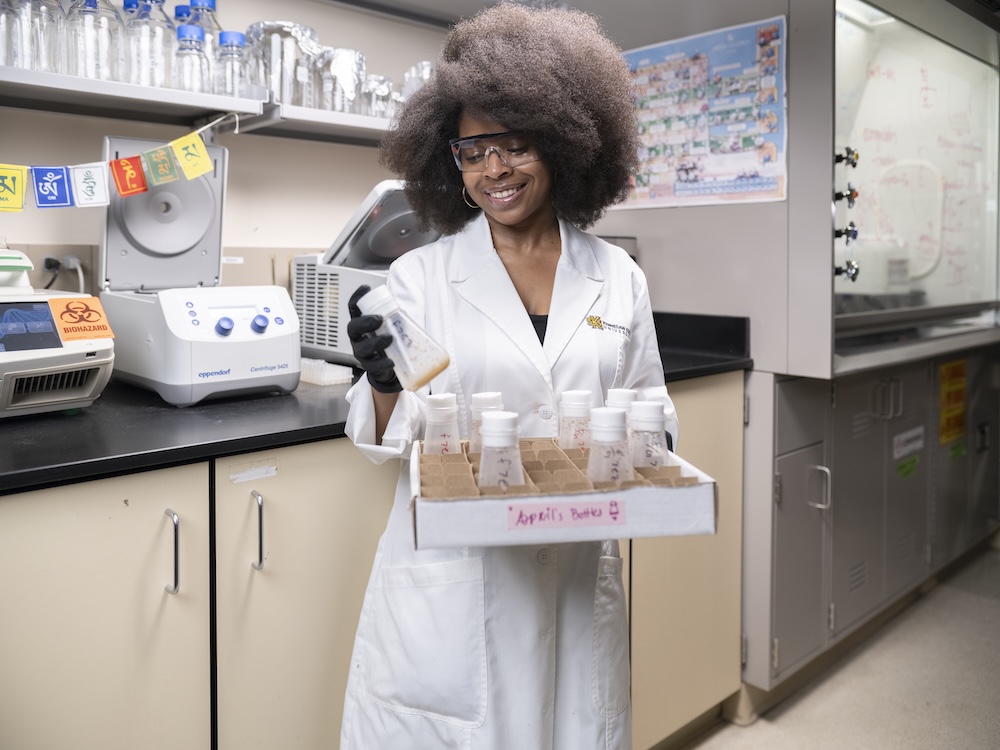
She’ll stand as an example of the Peach State Bridges to the Doctorate program’s effectiveness, having earned her Master of Science in Integrative Biology (MSIB) and acceptance into a Ph.D. program.
“I became interested in genetics and cell biology as an undergrad, and I knew the MSIB would allow me to develop that interest given the number of labs that work in those areas,” Ford said. “There was also the opportunity to join the NIH Peach State Bridges to the Doctorate training program. As the name implies, the purpose of this program is to train master’s students to help them bridge into a doctorate program. I’d say it worked.”
Ford, Jojo Croffie, and Lindsey Knight all earned their MSIB degrees, and thanks to enrichment through the Peach State Bridges to the Doctorate program, each will start a Ph.D. in the fall. Ford and Croffie will continue their doctoral studies at the University of Georgia while Knight will pursue her Ph.D. at the Georgia Institute of Technology.
“We're incredibly pleased with and proud of our Bridges trainees,” said Martin Hudson, professor of biology and co-founder of this iteration of the program, along with Associate Professor of Biology Melanie Griffin. “They're moving on to highly respectable Ph.D. programs, and we're excited to see where the next step will take them.”
The Peach State Bridges to the Doctorate program is funded by a T32 training grant from the National Institutes of Health, dedicated to developing the research talents of master’s students to transition to doctoral programs in biomedical sciences. Scholars can pursue either of KSU’s master’s degrees in the College of Science and Mathematics – the MSIB degree earned by this trio, or the Master of Science in Chemical Sciences.
While Croffie earned his bachelor’s in biology at Piedmont University, Ford and Knight earned theirs at KSU, then stuck around to earn their master’s degrees.
Ford mentioned the interest in genetics and cell biology from her undergraduate years and found a graduate mentor in Assistant Professor of Molecular and Cellular Biology Joanna Wardwell-Ozgo. Ford’s next stop is Athens – the Integrative Life Sciences program at the University of Georgia. She said the interdisciplinary nature of the program appealed to her because she’ll have constant engagement in various aspects of biology during her years there.
“It’s an umbrella program, so I get to rotate between labs of varying disciplines across biology before choosing a specific discipline,” she said. “I’ll be taking on a different topic for my dissertation research at UGA. At KSU, I studied molecular mechanisms and genetic regulation, but somewhere in my heart I hold love for evolution and evolutionary transitions. Given its integrative nature, UGA will be a fantastic place to bridge these interests.”
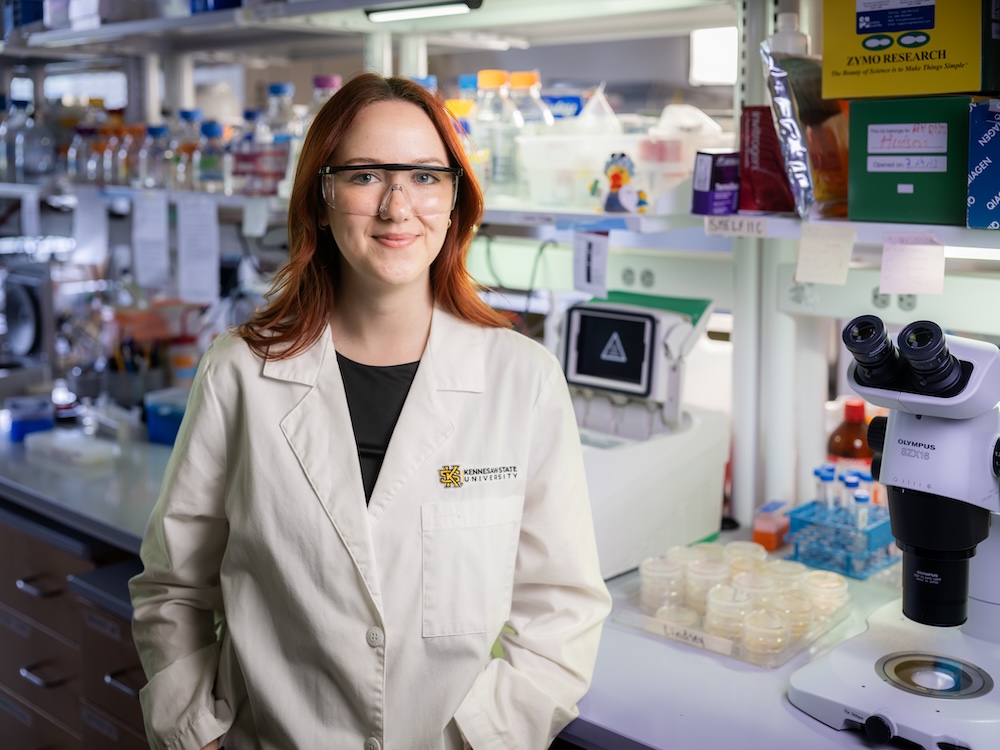
She will head to Midtown Atlanta and the Neuroscience and Neurotechnology Ph.D. program at Georgia Tech. She’ll be part of the second cohort of the program, which seeks to engage various communities in science. At KSU, Knight discovered an interest in storytelling dedicated to science, and she said she found the right place to pursue her doctorate.
“They emphasize a commitment to community outreach and engagement at the program, university, and city levels,” she said. “A large part of the reason I chose this program, aside from it being so new and open to student input, was the leadership team's commitment to making science understandable and engaging for various audiences. Finding ways to engage with the communities in and around Tech will make it much easier to follow through with my scientific storytelling beyond writing for publication.”
During her time at KSU, Knight drew inspiration from the research community and encouraged students to seek out those opportunities at any stage.
“The best thing I ever did was cold emailing Dr. Hudson and expressing how much I wanted to join his lab,” she said. “The connections you make here, especially in a research environment as close-knit as our lab and department, really last for life. Immersing myself in the research community at KSU has given me so many professional opportunities, helped me build so many friendships, and there really are no words to fully describe how impactful my time here has been on my growth as a person.”
Similarly, Ford credited the mentorship from Wardwell-Ozgo and the rest of the faculty in the Department of Molecular and Cellular Biology for giving her the skills to make discoveries and further her own knowledge.
“I urge people to send that cold email or step into that professor’s office if they’re seeking mentorship and experience – that’s the first step I took as an undergrad when I realized I wanted to do my Ph.D., and it opened doors for me,” Ford said. “The faculty really want to see all of us succeed. I’m lucky to have found a mentor who matched my mentee needs and pushed me beyond what I thought I could do. I'm so proud to be a Forever Owl, and I’ll miss KSU.”
– Story by Dave Shelles
Photos by Darnell Wilburn
Ph.D. student advances research regarding AI integration with devices with limited computing power
Recent NIH grants aim to improve parasite research, acquire crucial instruments
Kennesaw State students expand research horizons in India

Kennesaw State software engineering student develops AI-powered navigation system
A leader in innovative teaching and learning, Kennesaw State University offers undergraduate, graduate, and doctoral degrees to its more than 51,000 students. Kennesaw State is a member of the University System of Georgia with 11 academic colleges. The university's vibrant campus culture, diverse population, strong global ties, and entrepreneurial spirit draw students from throughout the country and the world. Kennesaw State is a Carnegie-designated doctoral research institution (R2), placing it among an elite group of only 8 percent of U.S. colleges and universities with an R1 or R2 status. For more information, visit kennesaw.edu.

