


News Releases

Latest Releases

Loading posts...
-

KSU researcher joins NSF-funded collaborative project to improve emergency communications
November 11, 2026
Kennesaw State University researcher Honghui Xu will receive $110,000 through a subaward from the University of Louisiana at Lafayette, the lead institution on a collaborative National Science Foundation (NSF) project to develop artificial intelligence (AI) technologies that improve emergency communications, while reducing energy consumption and protecting sensitive information.
-
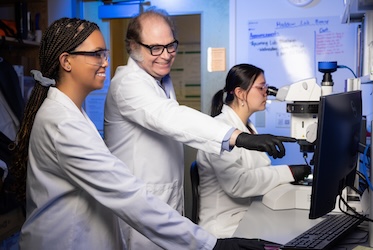
KSU researcher receives NIH grant to study 'forever chemicals'
November 10, 2026
Kennesaw State researcher Andrew Haddow has received a three-year grant from the National Institutes of Health (NIH) worth $517,956 to study the effects of per- and polyfluoroalkyl substances (PFAS), or “forever chemicals,” on mosquitoes.
-
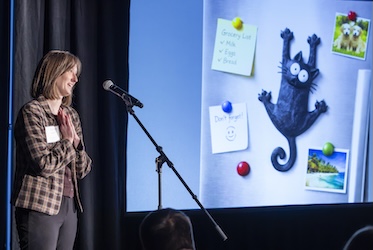
Faculty bring research to life for community leaders at PechaKucha Night
November 09, 2026
Kennesaw State University faculty researchers shared their work recently with leaders from business, community, and government partners at the Office of Research’s annual PechaKucha Night event held at Glover Park Brewery in Marietta.
-

Physics researcher earns NSF grant to improve gravitational-wave detectors
October 28, 2026
Kennesaw State researcher Kiran Prasai recently received a two-year grant worth nearly $180,000 to develop advanced mirror coatings materials for future detectors of gravitational waves from the far reaches of the universe, allowing astrophysicists to draw conclusions about activity in space.
-

Kennesaw State researcher uses wireless technology to improve soybean breeding
October 27, 2026
Detecting crop anomalies early could become easier for farmers thanks to research underway at Kennesaw State University. With support from a $131,863 National Science Foundation (NSF) grant, KSU researchers are developing wireless technology designed to monitor soybean crops and help farmers make more informed decisions.
-

Kennesaw State researcher explores virtual reality to improve student engagement in STEM
October 26, 2026
A Kennesaw State University researcher is exploring how virtual reality can help students stay focused and engaged during science and engineering laboratory activities. Supported by a $198,486 grant from the National Science Foundation (NSF), the research aims to help learners maintain attention, improve motor skill, and enhance learning in immersive virtual laboratories. Sungchul Jung, an assistant professor of gaming in KSU's College of Computing and Software Engineering, is leading the two-year project.
-

Kennesaw State researcher shines light on Joro spiders
October 22, 2026
A nationally renowned expert and myth-buster on Joro spiders, Andy Davis seeks to expand knowledge on the invasive arachnids. Joro spiders came to the U.S. via East Asia in the mid-2010s, possibly in egg sacs attached to shipping containers, and their population has only increased since then.
-

Kennesaw State researcher receives $250,000 NSF grant to enhance construction education
October 21, 2026
Kennesaw State University researcher Minsoo Baek has received a $250,000 National Science Foundation (NSF) grant to develop technology that could help construction management students navigate real-world challenges before entering the workforce.
-

NSF-funded research aims to make AI a more reliable tool for heart testing
October 16, 2026
An artificial intelligence (AI) system can help identify heart problems from electrocardiograms (ECGs), tests that record the heart’s electrical activity to help doctors diagnose heart conditions. However, doctors may not always be able to interpret the information generated. Kennesaw State University researcher Sagnik Dakshit is working to bridge that gap.
-
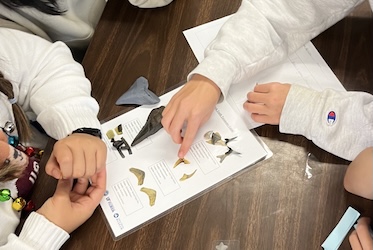
Kennesaw State researcher brings AI lessons to life with shark teeth
October 13, 2026
A fossil shark tooth can tell a story about life millions of years ago. For Kennesaw State University researcher Christine Wusylko, it can also help students understand artificial intelligence (AI). Wusylko and collaborators at the University of Florida recently received a National Science Foundation grant for Shark AI, a project that guides middle school science students through building and evaluating computer vision models that can classify real fossil shark teeth.