KENNESAW, Ga. | Oct 13, 2026
Wusylko and collaborators at the University of Florida recently received a National Science Foundation grant for Shark AI, a project that guides middle school science students through building and evaluating computer vision models that can classify real fossil shark teeth. The full grant is $254,000, and Wusylko received a sub-award of $24,000 to help the team expand the project to Georgia teachers and explore ways to keep it going after funding ends.
Led by University of Florida paleontologist Bruce MacFadden, the project is a collaboration between paleontologists, engineers, museum educators, and educational technology researchers.
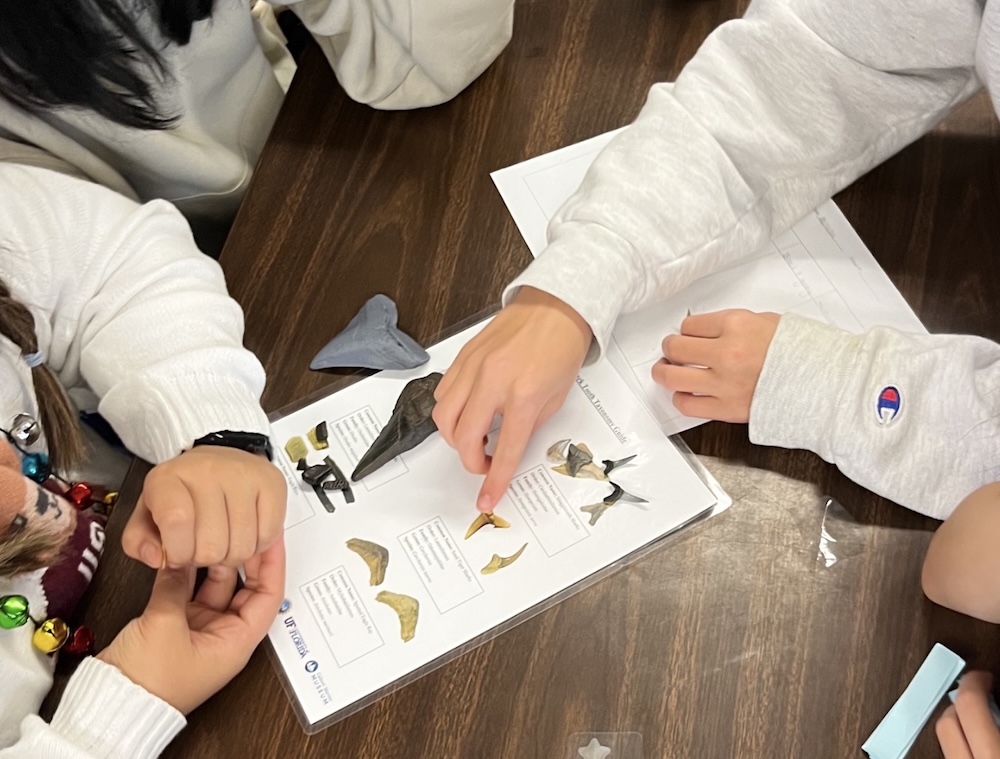
Using a free platform called Google Teachable Machine, students upload photographs of fossil shark teeth and train an AI model to classify them by species or tooth function. They then test the model’s accuracy and revise their training data when it makes mistakes.
The process helps students understand how AI learns from data and why its predictions can sometimes be wrong.
“The models are made by humans, and there’s ways that we can introduce bias, either intentionally or not,” said Wusylko, an assistant professor of instructional technology in the Clarice C. and Leland H. Bagwell College of Education.
Students also examine real fossil teeth, exploring how their shapes helped sharks cut, grasp or crush food. Those hands-on experiences connect science lessons with the work of researchers.
“The children are mirroring what real paleontologists are doing right now,” she said.
Inspired by her experience as a former K-12 science and technology teacher, Wusylko says her research is focused on ways technology can help children learn complex STEM topics.
“A lot of my research is based on some struggles I saw students have in the classroom, learning complex STEM topics.”
Her work on Shark AI also supports teachers, helping them build confidence using AI in their classrooms. The project’s curriculum is freely available, and the team has also developed a related curriculum, Chewing on Change, that uses fossil horse teeth and computer vision to teach evolution and machine learning.
The study is funded by NSF #2147625
– Story by Christin Senior
Photo provided
A leader in innovative teaching and learning, Kennesaw State University offers undergraduate, graduate, and doctoral degrees to its more than 51,000 students. Kennesaw State is a member of the University System of Georgia with 11 academic colleges. The university's vibrant campus culture, diverse population, strong global ties, and entrepreneurial spirit draw students from throughout the country and the world. Kennesaw State is a Carnegie-designated doctoral research institution (R2), placing it among an elite group of only 8 percent of U.S. colleges and universities with an R1 or R2 status. For more information, visit kennesaw.edu.