


KENNESAW, Ga. | Oct 2, 2026
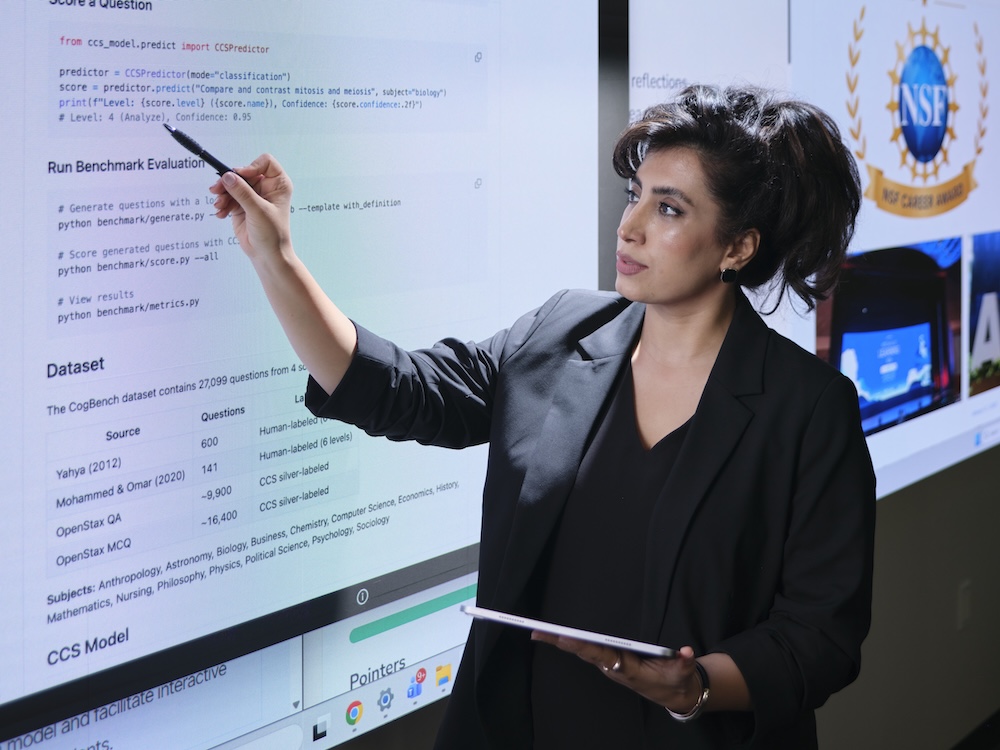
The five-year award will support Dehbozorgi’s work developing an AI-powered decision support system to assist STEM educators make informed, evidence-based instructional decisions while keeping human expertise at the center of this process. In turn, the system will learn from educators’ experiences and feedback, contributing to a growing body of shared knowledge for the broader STEM education community.
“I was incredibly excited and also deeply grateful to hear this news,” Dehbozorgi said. “I had a moment of joyful pause and reflection, thinking about the years of hard work, persistence and growth that brought me to this point.”
College of Computing and Software Engineering Dean Darryl Ahner commended Dehbozorgi and said her work reflects the college’s growing research impact.
“Dr. Dehbozorgi’s NSF CAREER Award is an outstanding achievement and a testament to the innovative research taking place within CCSE,” Ahner said. “Her work brings together artificial intelligence, education and the human element in a way that has the potential to make a meaningful impact on educators and students. We are incredibly proud of her accomplishment.”
Dehbozorgi’s project will focus on developing a conversational AI assistant that educators can interact with to identify research-supported teaching practices and receive personalized recommendations based on their instructional goals and challenges they face in the classroom.
For example, an instructor could tell the system that students are struggling with a particular concept or that classroom engagement is low. The AI assistant would consider the instructor’s goals and specific teaching environment before suggesting strategies that could be adapted for that classroom.
Dehbozorgi said one challenge facing STEM educators is the amount of information available about new pedagogical approaches. Her project aims to make that knowledge easier to access and more tailored to individual educators’ needs while allowing instructors to determine which approaches work best for their students
“The goal is not to replace their judgment or let the AI decide for them,” Dehbozorgi said. “It’s mainly to give them better support to make informed decisions.”
The research will also examine issues surrounding trust, accuracy, transparency, and privacy while ensuring educators remain at the center of the decision-making process.
“The broader question is not just if we can use AI in education, but how we can use it responsibly and effectively, while keeping humans in the loop so that it can really make a meaningful impact in education,” she said.
Kennesaw State students will also play an important role in the project. Undergraduate, master’s, and doctoral students will have opportunities to contribute to the design, development and evaluation of the framework. Students will work in areas including artificial intelligence, software development, data analysis, user experience design, and research. Summer internship opportunities are also planned.
The research could also help prepare students for a workforce increasingly shaped by artificial intelligence. Dehbozorgi said educators need to understand how to use AI, evaluate its output, recognize its limitations, and apply the technology responsibly.
“Teaching is deeply human, and we are dealing with learners with different backgrounds, learning styles and paces,” Dehbozorgi said. “Combining the strengths of both human expertise and AI and using them in a meaningful way is really promising in the educational field.”
Dehbozorgi credited CCSE and KSU’s Office of Research for supporting her work. She said the university’s focus on student success and applied research makes it a strong environment for the project.
By the end of the five-year project, Dehbozorgi hopes the research will produce a trustworthy framework that can extend beyond Kennesaw State.
– Story by Raynard Churchwell
Photos by Darnell Wilburn

Kennesaw State researcher receives NIH Grant to study sleep apnea

Ph.D. student advances research regarding AI integration with devices with limited computing power

Student cooks up success through engineering and content creation
Kennesaw State researcher developing safer, more efficient computing systems for intelligent vehicles
A leader in innovative teaching and learning, Kennesaw State University offers undergraduate, graduate, and doctoral degrees to its more than 51,000 students. Kennesaw State is a member of the University System of Georgia with 11 academic colleges. The university's vibrant campus culture, diverse population, strong global ties, and entrepreneurial spirit draw students from throughout the country and the world. Kennesaw State is a Carnegie-designated doctoral research institution (R2), placing it among an elite group of only 8 percent of U.S. colleges and universities with an R1 or R2 status. For more information, visit kennesaw.edu.

