


KENNESAW, Ga. | Jul 21, 2026
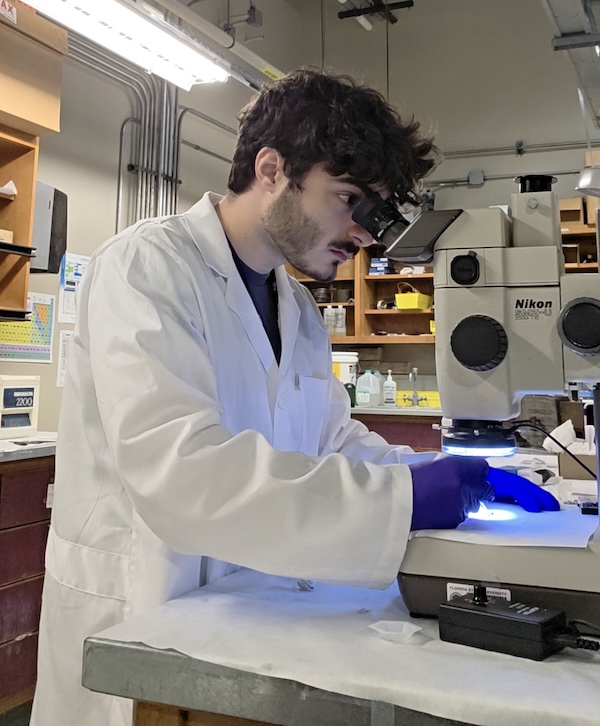
Bonvissuto is working on a project involving quantum materials that have magnetic properties and medical applications such as X-rays and MRIs. These materials also play a role in efficient cooling and thermoelectric power.
The winner of the 2025 Birla Carbon Scholars Symposium, Bonvissuto recently took a break from his work at the Florida State-based lab to talk about a day at the “MagLab,” how KSU prepared him for this experience, and what he hopes to achieve in the future.
Q: What are you working on this summer?
A: My research at Kennesaw State University and at the National High Magnetic Field Laboratory focuses on rare-earth intermetallic compounds. These materials combine rare-earth elements with metals or related elements and can exhibit unusual magnetic and electrical properties. Before studying these materials, we first grow high-quality crystals using the molten-flux method. The starting elements are placed in a crucible, sealed inside a quartz tube under vacuum, heated above 1000C and then slowly cooled. As the material cools, the atoms arrange themselves into an ordered crystal structure. We then use X-ray diffraction to determine whether the desired crystal has formed. X-rays scatter from the atoms and produce a pattern that acts like a fingerprint for the crystal structure. By comparing this pattern with known data, we can identify the material and confirm its structure.
Q: What does a day in your life look like?
A: Each day, it’s a million different things. It’s 9 a.m. to 5 p.m., and it doesn't feel like it. Time just flies by. It’s a lot of walking around and working with my hands. I spend very little time at a desk, which I love. And even when I am at my desk, I’m doing analysis on data that I’ve taken, and that's fun. It’s a lot of fixing things; you’d be surprised there’s a lot of things at a national lab that need fixing, so we run around all day and ask, ‘What can we do here?’ Overall, the mission is to grow this specific family of crystals, explore their thermal properties, and see what we can use them for.
Q: At KSU you work with Associate Professor of Physics Chetan Dhital in a lab dedicated to applications of magnetic technology. Is your MagLab project pretty close to what you work on at KSU?
A: At Kennesaw State, Dr. Dhital’s group primarily studies the magnetic properties of these compounds. My work at the MagLab has focused on their thermoelectric properties, or their ability to convert temperature differences into electrical voltage. This process is known as the Seebeck effect. When one side of a conducting material is hotter than the other, charged particles move from the hot side toward the cold side, producing a voltage. We measure this response over a wide range of temperatures to identify materials that can generate larger voltages from smaller temperature differences. Efficient thermoelectric materials could one day be used to generate electricity from waste heat or provide cooling without conventional refrigerants or moving parts.
Q: What do you hope to accomplish this summer?
A: My goal for the summer is to get experience using these more specialized characterization techniques that I wouldn’t be able to get elsewhere. Both Dr. Dhital and then my supervisors here have been saying that the techniques that we get to use are universal tools to use in condensed matter physics. I’m building that tool set, because I intend to go to graduate school, and these are things that I get to add to my CV. That experience is really valuable, and getting to use these more expensive specialized machines, it’s not an opportunity that I would necessarily have otherwise.
Q: How did Kennesaw State prepare you for the MagLab experience?
A: One thing that I’ve always said about KSU’s physics program is that research is its strength. If a professor wants to form a research group, undergraduates are always involved. For the students, it is extraordinarily valuable. I just don’t see it elsewhere. KSU has been instrumental in preparing me to be at the MagLab, and in some regards, I’m a step ahead. I wake up every day, and I love the work that I do. I feel like the stars have aligned where I’m speaking to my principal investigators about the possibility of returning as a graduate student. Florida State is one of the schools that I’ll be applying to, and there’s plenty others as well. But KSU has been immensely important for that.
– Story by Dave Shelles
Photos provided

Engineering student creates robotic hand designed to track patient health
Engineering student uses NASA data to study distant star systems
Engineering student combines technical and marketing skills through hands-on experiences
Recent NIH grants aim to improve parasite research, acquire crucial instruments
A leader in innovative teaching and learning, Kennesaw State University offers undergraduate, graduate, and doctoral degrees to its more than 51,000 students. Kennesaw State is a member of the University System of Georgia with 11 academic colleges. The university's vibrant campus culture, diverse population, strong global ties, and entrepreneurial spirit draw students from throughout the country and the world. Kennesaw State is a Carnegie-designated doctoral research institution (R2), placing it among an elite group of only 8 percent of U.S. colleges and universities with an R1 or R2 status. For more information, visit kennesaw.edu.

