


KENNESAW, Ga. | Jul 14, 2026
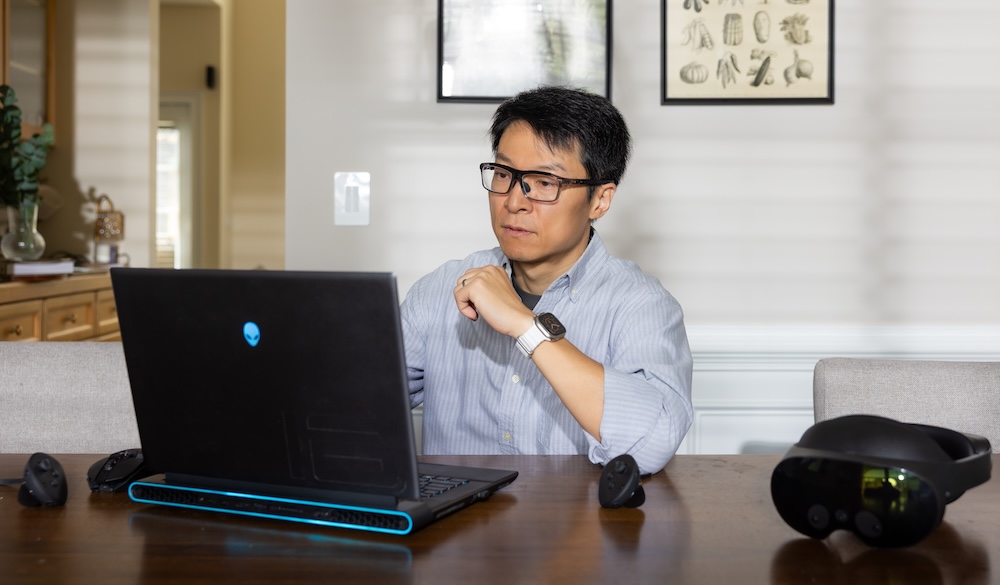
Funded by a two-year grant from the National Science Foundation, Lei Zhang, a human-computer interaction researcher in College of Computing and Software Engineering, is building a virtual reality system that lets bereaved parents meet, share memories, and process grief together in a shared immersive digital space, inspired by his own experiences losing a child to cancer.
“When a child is being treated for cancer, parents often live at the hospital for an extended period of time, building close bonds with the medical team and other parents going through the same thing,” Zhang said. “But when the treatment fails and the child dies, parents go back home to their lives, and those bonds are cut off overnight.”
Zhang wants to help those parents hold onto those connections. Already a year into the project, Zhang has partnered with collaborators Erica Kaye from St. Jude Children's Research Hospital, Wendy Lichtenthal from the University of Miami, and a group of KSU graduate students to develop three virtual reality software prototypes. They are designed to help grieving parents reconnect, share memories and participate in therapeutic activities in ways traditional video conferencing cannot.
“We’re moving into the next stage,” Zhang said. “The prototypes are nearly complete. We’re preparing to evaluate how parents experience them and whether virtual reality can help create stronger feelings of connection than existing online support.”
Zhang’s idea for the project came from a personal loss. In 2020, after losing their 2-year-old daughter Lexie to acute myeloid leukemia, Zhang and his wife participated in bereavement programs offered by St. Jude Children’s Research Hospital, Lexie’s treatment hospital. Having participated in the program for three consecutive years, they experienced both the healing power of connecting with other parents as well as the limitations of online support groups, inspiring Zhang to explore whether immersive technology could help bridge that gap.
“When you talk to someone on Zoom or Teams, behind the barrier of a computer screen you still feel like you’re in two different spaces. This phenomenon is known as the fourth wall effect,” Zhang said. “Immersive virtual reality gives you a feeling of presence, like you’re actually together in the same space with that person.”
Zhang’s three VR prototypes were built with help from a small team of KSU graduate students: Sinha Afroz, a Ph.D. student in computer science; Mason Prather, a master’s student in software engineering; and Ian Skoonberg, a master’s student in computer science. Each student took the lead on developing one of the VR experiences, working alongside Zhang to bring the prototypes from concept to testing.
The first prototype is a multi-user support group experience where parents can interact and share their children’s stories in a virtual space as avatars. The second is a generative AI-assisted guided imagery mindfulness therapy that creates immersive environments based on parents’ memories and emotions.
The third is inspired by the Wind Phone, a telephone booth that was set up in Japan by a man mourning his brother after the 2011 tsunami, which will allow parents to use a virtual phone to call and “talk” to their child.
For Skoonberg who designed the Wind Phone aspect, the project was deeply personal. “My specific focus is related to grief practices, which has been very relevant to me," he said. “I lost my childhood best friend to suicide about a year ago. The work I am doing is about creating grief rituals that might benefit others.”
Once the prototypes are polished, this fall he will partner with the Quality of Life program at St. Jude Children’s Research Hospital in Memphis to recruit bereaved parents for testing. Parents will participate in a longitudinal study lasting at least four months, with the study measuring grief intensity, feelings of connectedness, anxiety and depression.
“If this proves to be effective,” Zhang said, “it could become another option for parents to connect with one another and support each other wherever they are.”
This work is supported by the National Science Foundation’s Computer and Information Science and Engineering Research Initiation Initiative under Award No. 2451461.
– Story by Christin Senior
Photo by Matt Yung
Kennesaw State researcher earns prestigious NSF CAREER Award
Kennesaw State researcher receives NIH Grant to study sleep apnea
Ph.D. student advances research regarding AI integration with devices with limited computing power
Kennesaw State researcher developing safer, more efficient computing systems for intelligent vehicles
A leader in innovative teaching and learning, Kennesaw State University offers undergraduate, graduate, and doctoral degrees to its more than 51,000 students. Kennesaw State is a member of the University System of Georgia with 11 academic colleges. The university's vibrant campus culture, diverse population, strong global ties, and entrepreneurial spirit draw students from throughout the country and the world. Kennesaw State is a Carnegie-designated doctoral research institution (R2), placing it among an elite group of only 8 percent of U.S. colleges and universities with an R1 or R2 status. For more information, visit kennesaw.edu.

