


KENNESAW, Ga. | Sep 11, 2026

Hoeh is helping develop an AI-powered augmented reality navigation system that lets users ask for directions and guides them through complex indoor spaces. The technology could improve accessibility for people with cognitive disabilities while also helping first responders navigate unfamiliar buildings more quickly.
Using a Meta Quest headset and other consumer technology, the system allows users to ask for directions without needing to know a specific room number or location beforehand.
“You could say, ‘Guide me to the nearest bathroom,’ and then it’ll guide you there,” Hoeh said. “You don’t have to know the room number or exactly what the location is called because you can ask for what you need in natural language, and if something is unclear, the system can ask for clarification.”
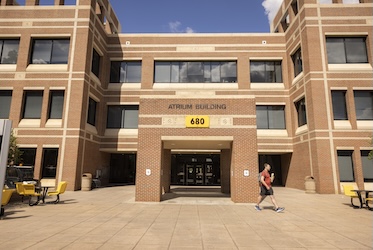
The project has already been tested in the Atrium Building on KSU’s Marietta Campus. Unlike traditional navigation applications, Hoeh said the system is being developed specifically for indoor environments and is designed to operate more like a conversation.
A collection of AI agents processes the user’s request, searches available location information, and identifies the best destination before sending directions back to the headset.
Hoeh said the hands-free approach could be especially useful for people who may have difficulty navigating unfamiliar spaces.
“If you have to navigate around an unfamiliar building quickly, that can be very overwhelming,” Hoeh said. “We hope people with certain impairments and first responders will find this useful.”
Brooke Zhao, assistant professor of gaming in KSU’s College of Computing and Software Engineering, said Hoeh has shown persistence throughout the project.
“Robert has shown a tremendous amount of initiative and persistence throughout this project,” Zhao said. “It’s exciting to see an undergraduate student so early in his academic career contribute to research that has the potential to make a meaningful impact.”
Hoeh, a Mableton, Georgia, native and graduate of Wheeler High School’s magnet program, became involved with the project during his first year at Kennesaw State through the Summer Undergraduate Research Program.
“The experience was really great, even though it was frustrating at points,” Hoeh said. “It helped get the ball rolling with my research aspirations, and now I’m entering my second year with an almost published paper.”
Progress on the system has required patience. Hoeh said the first prototype returned a correct result for only one test query, leading to continued testing, coding and troubleshooting.
“There have been times when I’ve had to grind away at bugs in the code for hours,” Hoeh said. “When it finally works, it’s really satisfying to see.”
One of those moments came while Hoeh was preparing to present the project at KSU’s Fall Symposium of Student Scholars. After working against a tight deadline, the team successfully demonstrated an early version of the system.
“We were really rushing to get everything working before the deadline,” Hoeh said. “Once we got the system working, that’s when I realized, ‘Wow, this really does work.’”
Hoeh’s interest in computing began in high school, when he first learned to code. At KSU, he has continued building those skills through undergraduate research and as a tutor in the CCSE Tutoring Lab.
“KSU has so many great programs to help out computing students, and it’s been great getting to know the faculty and staff here,” Hoeh said. “There are a lot of opportunities for undergraduate students to get involved and build experience.”
The project’s next phase will focus on completing the system and conducting user studies to determine how useful the technology could be for different populations. For Hoeh, the project also shows how artificial intelligence can be used to address real-world challenges.
“A lot of what you see about AI can be very negative, but I do believe this kind of technology can genuinely help people,” Hoeh said. “We just need to find the right applications for it.”
– Story by Raynard Churchwell
Photo provided
Kennesaw State researcher earns prestigious NSF CAREER Award
Kennesaw State researcher receives NIH Grant to study sleep apnea
Ph.D. student advances research regarding AI integration with devices with limited computing power
Kennesaw State researcher developing safer, more efficient computing systems for intelligent vehicles
A leader in innovative teaching and learning, Kennesaw State University offers undergraduate, graduate, and doctoral degrees to its more than 51,000 students. Kennesaw State is a member of the University System of Georgia with 11 academic colleges. The university's vibrant campus culture, diverse population, strong global ties, and entrepreneurial spirit draw students from throughout the country and the world. Kennesaw State is a Carnegie-designated doctoral research institution (R2), placing it among an elite group of only 8 percent of U.S. colleges and universities with an R1 or R2 status. For more information, visit kennesaw.edu.

