KENNESAW, Ga. | Jul 7, 2026
As geopolitical conflicts continue to disrupt global energy markets, Kennesaw State University Ph.D. student Nzubechukwu Ohalete found that artificial intelligence (AI) can identify warning signs of major oil crises weeks before they occur. His research suggests governments and businesses could use those early warnings to better prepare for potential disruptions.
A Ph.D. student in Data Science and Analytics in Kennesaw State's College of Computing and Software Engineering, Ohalete examined whether artificial intelligence models (through natural language
processing) could identify warning signs of major oil crises. He focused on the 2026
closure of the Strait of Hormuz, a waterway that carries about 20 percent of the world's
oil supply each day. Financial-focused AI models detected warning signs of the crisis
47 days before the waterway closed, significantly outperforming general-purpose AI
models.
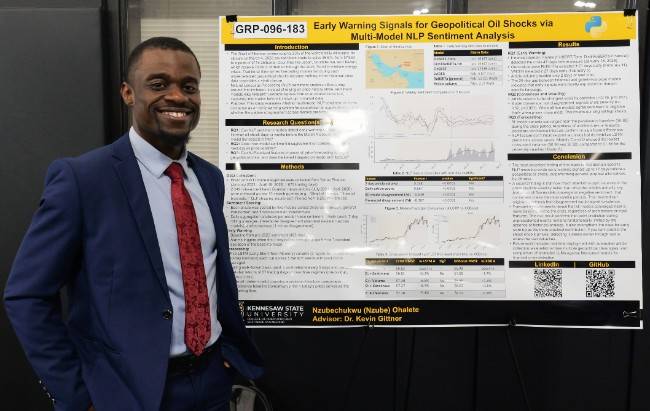
"Financially trained models are more powerful than general-purpose models for this kind of prediction," Ohalete said. "That means policymakers and other decision-makers could use those domain-specific models to study trends and make better decisions."
The findings highlight how specialized AI tools can help solve complex real-world problems by providing earlier insights into emerging global events.
"Nzubechukwu's research demonstrates how artificial intelligence can move beyond analyzing past events to helping us anticipate future challenges," said CCSE Dean Darryl Ahner. "By combining advanced AI techniques with real-world geopolitical data, he is developing innovative approaches that could help governments, industries, and communities make more informed decisions before crises unfold. This work reflects the kind of impactful, interdisciplinary research our students are conducting to address complex global problems."
Originally from Nigeria, Ohalete earned his bachelor's degree in mathematics before discovering data science, a field that allowed him to apply mathematical problem-solving to real-world challenges. After earning a master's degree in applied statistics, he joined Kennesaw State's Ph.D. program in Data Science and Analytics in 2022.
For the project, Ohalete analyzed nearly two years of news articles using natural language processing to determine whether AI could recognize patterns that signaled an impending geopolitical crisis. The financial-focused models identified a potential spike in oil prices on Jan. 16, 47 days before the Strait of Hormuz closed on March 4. General-purpose models, meanwhile, detected warning signs only 27 days before the event.
The study also found a strong relationship between news coverage and oil price volatility. As reporting on the Strait of Hormuz increased, oil prices became more volatile.
"When there is a lot of buzz in the news about an issue, it may signal that something important is about to happen," Ohalete said. "One practical takeaway is to keep your ears to the ground."
The research also challenged one of Ohalete's expectations. He expected that combining news sentiment with historical oil prices would improve future price predictions. Instead, models using both sources of information performed about the same as those using historical prices alone, suggesting that news analysis may be more valuable for early warning than traditional price forecasting during unprecedented events.
The findings could help governments, businesses, and investors better prepare for geopolitical disruptions by identifying potential supply chain risks before markets react.
Story by Raynard Churchwell
Photo submitted
A leader in innovative teaching and learning, Kennesaw State University offers undergraduate, graduate, and doctoral degrees to its more than 51,000 students. Kennesaw State is a member of the University System of Georgia with 11 academic colleges. The university's vibrant campus culture, diverse population, strong global ties, and entrepreneurial spirit draw students from throughout the country and the world. Kennesaw State is a Carnegie-designated doctoral research institution (R2), placing it among an elite group of only 8 percent of U.S. colleges and universities with an R1 or R2 status. For more information, visit kennesaw.edu.