KENNESAW, Ga. | May 28, 2026
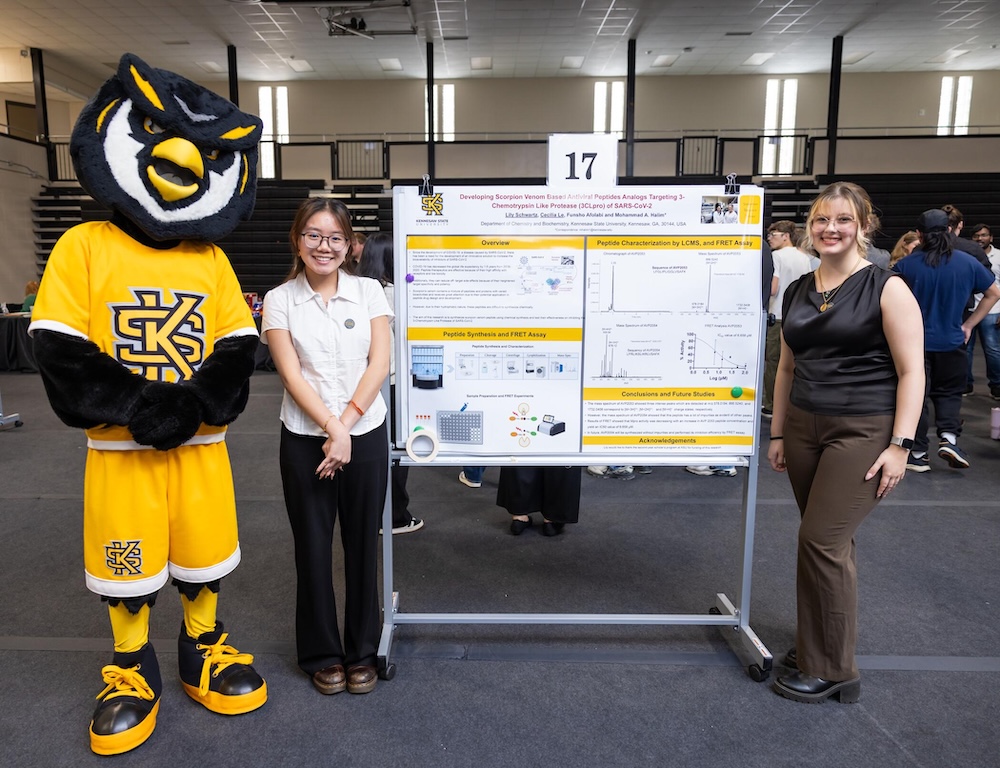
The Kennesaw State University juniors met in the lab of Associate Professor of Biochemistry Mohammad Halim, and a partnership flourished – as did a friendship. They presented research into the effectiveness of certain peptides in mitigating COVID-19 twice at the Symposium of Student Scholars, and have continued to make their way as undergraduate researchers.
“The way we think and the way we contribute to our projects really pushes us to do better,” Le said. “We’re both really curious and driven, and I’m glad we met when we did.”
The two first crossed paths through the First-Year Scholars program, each seeking a research opportunity from Day 1 of their college experience. A faculty member in the College of Science and Mathematics, Halim selected 10 students to continue his research into peptide therapeutics through analytical and computational methods, and paired Schwartz and Le because their availability coincided. The two slowly became friends, discovering a love of food and tea along with a love of research.
“We're very careful and thorough about things, and we have a very strong work ethic,” Schwartz said. “We always want to put our best foot forward and work as hard as we possibly can to create the best project possible. We both really like to learn, too, which fostered our ability to work together. Since we were taking slightly different classes, we had different knowledge and some different skill sets that we brought together and used to our advantage.”
In addition to the two presentations at KSU’s Symposium, Schwartz, a biochemistry major from Woodstock, presented at the National Conference on Undergraduate Research in April. Her project stemmed from the symposium presentation in Fall 2025, a research project on antiviral treatments for COVID-19 based on the chemical makeup of scorpion venom.
“Scorpion venom has very good proteins that we can use to inhibit the main processor of the COVID-19 virus,” she said. “So, we've been doing various analytical assays to synthesize the peptide and then test it to see what kind of inhibition efficiency it has to prevent the virus.”
A biology major from Snellville, Le initially sought research opportunities tangentially related to her major and found the human-focused research conducted in the Halim lab relevant, especially after a bioengineering class in high school spotlighted other aspects of science that can help people.
“I wanted to do mainly biology research because of my major,” she said. “When I went to Dr. Halim’s lab and he showed me around, I thought, ‘This is interesting. Who wouldn't want to work on peptide therapeutics that help with COVID or Alzheimer’s?’”
Schwartz and Le continued their project on peptide therapeutics into the Sophomore Scholars program. They became friends away from the lab, still connecting despite busy schedules as students and mentors. Le became a student teaching assistant (TA) for general chemistry and organic chemistry, and Schwartz worked as a supplemental instructor (SI) in the chemistry department along with tutoring KSU athletes.
“We’re both passionate about mentoring,” Le said. “I’m a TA and then outside of that, I help at my church a lot. I’m passionate about helping the next generation because they’re going to do so much for our world. It’s important that we support them as much as possible.”
The two also lined up summer opportunities that will further their knowledge and expertise in chemistry. Schwartz will spend the summer at KSU as an intern in the laboratory of Assistant Professor of Chemistry and Biochemistry Progyateg Chakma, where the research project involves peptoids, synthetic peptides, through combining polymer and materials chemistry with organic chemistry. Schwartz said that she hopes to gain a publication in addition to the enhanced research experience.
Le will head across the country to work at the National Laboratory of the Rockies in Denver, Colorado, on an environmentally important project involving sea plants and their importance as resources.
“The project is genetically engineering marine bacteria that can break down algae and seaweed because those water-based plants have useful natural resources that we need in the world, but the process to get those resources is harsh and expensive,” she said. “What we’re trying to do is make the recovery process more environment friendly as well as efficient instead of using harsh chemicals.”
The two said they’ll remain in touch though their academic work has started to diverge. Schwartz said she’ll take the bond with Le as another benefit of gaining experience in research; she and Le gained not just research partners but friends.
“Never underestimate the connections that you can build during your research journey,” Schwartz said. “That is just as important as your work on the project — developing those connections because they can take you into so many different opportunities and help fulfill your journey in so many different ways.”
– Story by Dave Shelles
Photos provided
A leader in innovative teaching and learning, Kennesaw State University offers undergraduate, graduate, and doctoral degrees to its more than 51,000 students. Kennesaw State is a member of the University System of Georgia with 11 academic colleges. The university's vibrant campus culture, diverse population, strong global ties, and entrepreneurial spirit draw students from throughout the country and the world. Kennesaw State is a Carnegie-designated doctoral research institution (R2), placing it among an elite group of only 8 percent of U.S. colleges and universities with an R1 or R2 status. For more information, visit kennesaw.edu.