KENNESAW, Ga. | May 1, 2026
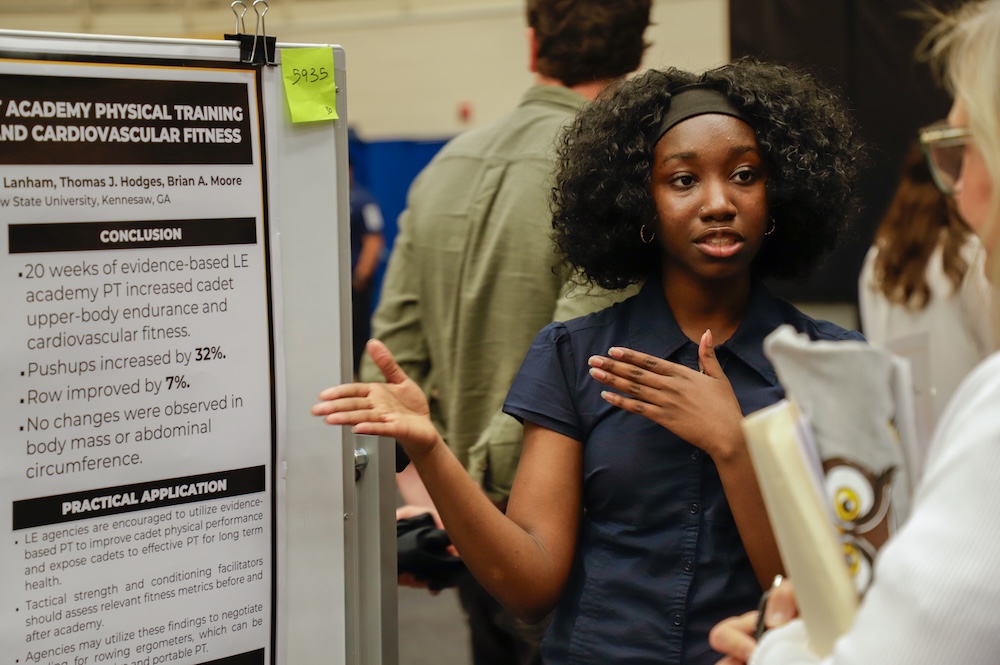
KSU’s first Symposium of Student Scholars on May 10, 1996 featured 17 research projects.
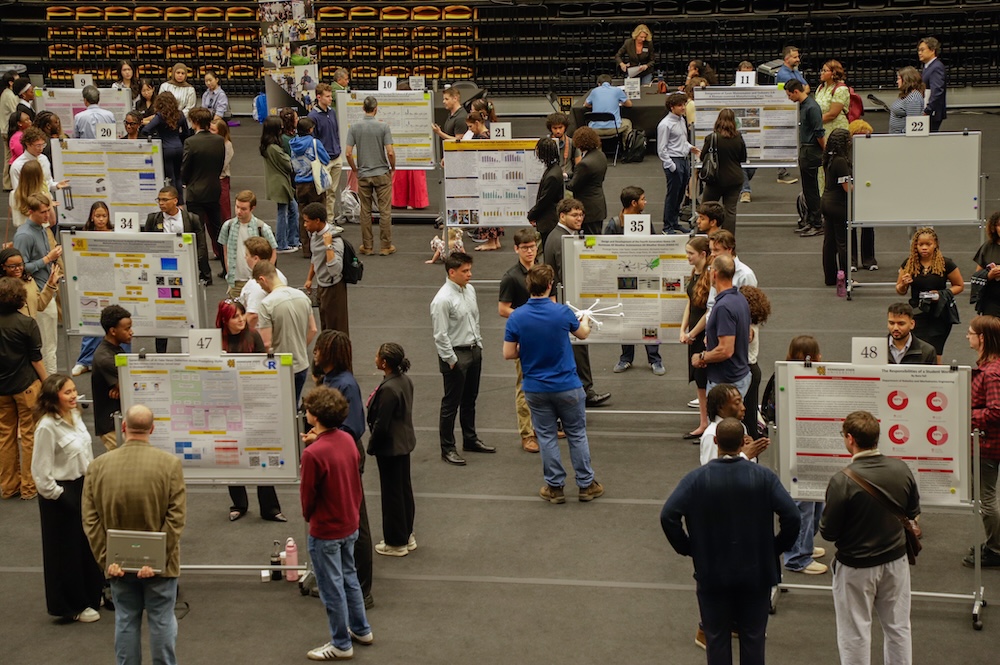
However, this spring, hundreds of students gathered inside Vystar Arena to present nearly 500 research projects, ranging across disciplines and including all nine academic colleges.
“The 30th anniversary gave us an opportunity to reflect on how far we’ve come while also looking ahead,” Executive Director of Undergraduate Research Amy Buddie said. “It underscored the vital role undergraduate research plays in preparing students not just for graduate study or careers, but for thoughtful, engaged citizenship. Events like this are where ideas take root, collaborations begin, and future leaders emerge.”
Edward Whitehurst, Sean Clark, James Greer and Caillou Guzman won first place in the undergraduate category for their project, 3D Visualization of a Local Freshwater Reservoir Using Terrestrial LiDAR (Laser Scanner). Assistant Professor of Geospatial Sciences and Geography Ranbir Kang served as faculty mentor.
“I'm incredibly grateful to have won,” Whitehurst said. “I’m especially thankful to Dr. Kang for the opportunity to work with him and for his feedback throughout the entire project.”
The team’s project, part of the First-Year Scholars Program, used a laser scanning tool called LiDAR to create a detailed 3D model of the dam at Frey Lake in Kennesaw. The team scanned the reservoir 37 times from different locations, producing more than 800 million data points.
This work provides a new lens to look at freshwater landscape by curating high-resolution spatial data that different agencies can use to manage those landscapes.
“The work was difficult, took many hours, and was sometimes boring, but working with a group so enthralled and with instruments and software so interesting made it worth it and rewarding,” Greer said.
Kang expressed how impressed he was with the students’ dedication to the work, sometimes having to go out into the field over the weekends or on holidays.
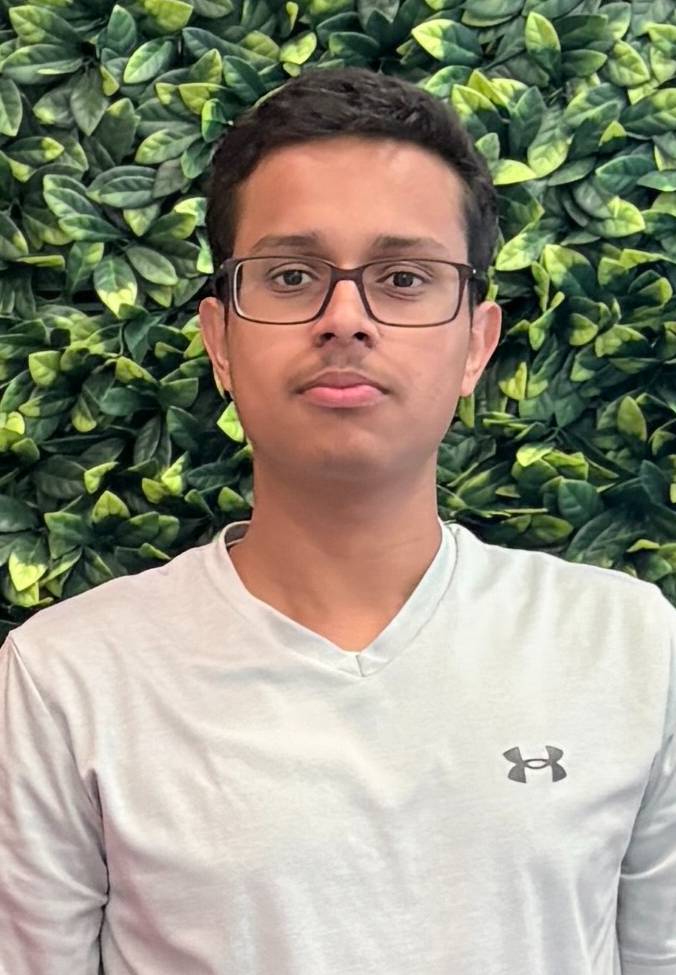
The team is one of two freshmen-led projects to place in the undergraduate category, joining Azam Shahbz, whose project, Adaptive Deployment and Reliability Optimization of an Autonomous Mobile Courier for Clinical Environments, placed third.
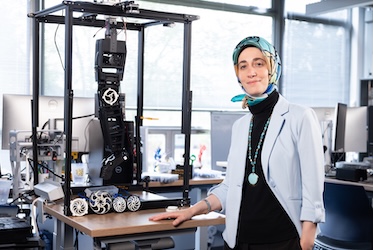
Regina Martinez Moctezuma and Britt Walker placed second with their project, Design and Preliminary Evaluation of a Compliant Rolling-Contact Bipedal Robot Guided by Human Motion Data.
The College of Science and Mathematics swept the top three places in the graduate competition, with Shaila Akter’s project, The Conserved SYLS Motif Is Essential for Akirin Function in Early Myogenesis, placing first.
Akter’s work, which was guided by Associate Professor of Developmental Biology Anton Bryantsev, pinpoints the SYLS motif, a sequence of amino acids, as essential for muscle fiber size and function, which could lead to new insights in understanding muscle development and potential therapies.
Graduate student Benjamin Angalet placed second with his project, Morphological Variation in the Lingual Glands of Wild American Alligator Populations, while Blaise Williams landed a third-place finish with his project, Tuning Polycyclic 1,2 BN Heteroarene Photophysics via Electron Deficient Heterocycle Substitutions.
“This milestone year carried a special energy — not only because it marks three decades of celebrating student research, but because it showcased how our programs have evolved to support increasingly interdisciplinary and impactful scholarship,” Buddie said.
First-Place Graduate Student
Title: The Conserved SYLS Motif Is Essential for Akirin Function in Early Myogenesis
Student: Shaila Akter
Mentor: Anton Bryantsev
Second-Place Graduate Student
Title: Morphological Variation in the Lingual Glands of Wild American Alligator Populations
Graduate Student: Benjamin Angalet
Undergraduate Students: Chelsea Holmes, Chloe Segars, Kamryn Moss, and Chase Cheeks
Mentor: Nicholas Green
Third-Place Graduate Student
Title: Tuning Polycyclic 1,2 BN Heteroarene Photophysics via Electron Deficient Heterocycle Substitutions
Student: Blaise Williams
Mentor: Carl Saint-Louis
First Place Undergraduate
Title: 3D Visualization of a Local Freshwater Reservoir Using Terrestrial LiDAR (Laser Scanner)
Students: Edward Whitehurst, Sean Clark, James Greer, and Caillou Guzman
Mentor: Ranbir Kang
Second Place Undergraduate
Title: Design and Preliminary Evaluation of a Compliant Rolling-Contact Bipedal Robot Guided by Human Motion Data
Graduate Student: Rob Montgomery
Undergraduate Students: Regina Martinez Moctezuma and Britt Walker
Mentor: Ayse Tekes
Third Place Undergraduate
Title: Adaptive Deployment and Reliability Optimization of an Autonomous Mobile Courier for Clinical Environments
Student: Azam Shahbaz
Mentor: Razvan Voicu and Muhammad Hassan Tanveer
– Story and photos by Alyssa Ozment
A leader in innovative teaching and learning, Kennesaw State University offers undergraduate, graduate, and doctoral degrees to its more than 51,000 students. Kennesaw State is a member of the University System of Georgia with 11 academic colleges. The university's vibrant campus culture, diverse population, strong global ties, and entrepreneurial spirit draw students from throughout the country and the world. Kennesaw State is a Carnegie-designated doctoral research institution (R2), placing it among an elite group of only 8 percent of U.S. colleges and universities with an R1 or R2 status. For more information, visit kennesaw.edu.