


KENNESAW, Ga. | Jul 13, 2026
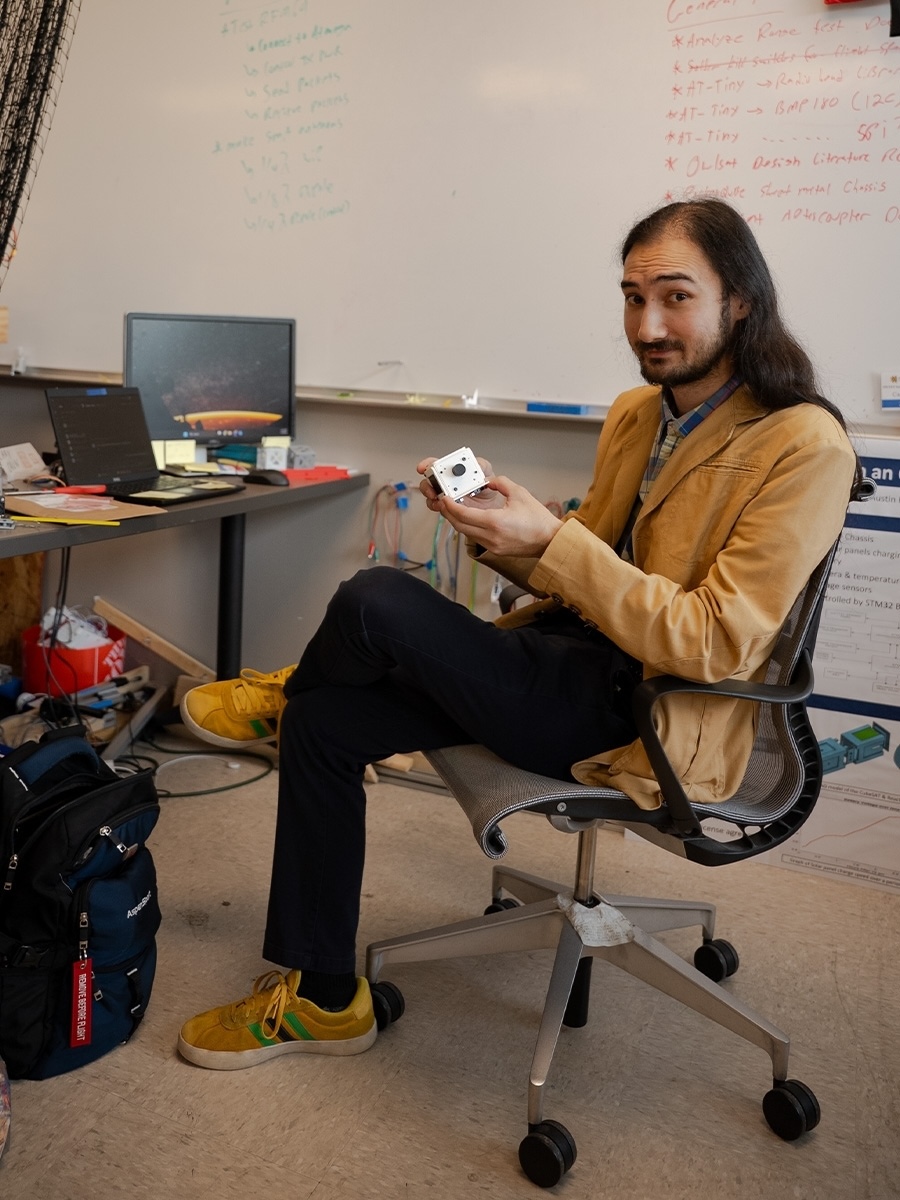
Now, the Kennesaw State University alum is helping students pursue that same dream. Chun, who earned his bachelor's degree in mechanical engineering from KSU in 2021 and his Ph.D. in interdisciplinary engineering in 2025, is sharing his passion as a part-time assistant professor of robotics and mechatronics engineering. Together, they are developing a PocketQube, a miniature satellite that provides hands-on aerospace engineering experience while laying the foundation for what could become the first KSU-built satellite launched into orbit.
Residing in the Southern Polytechnic College of Engineering and Engineering Technology, the project is based in the Modular Aerospace and Robotic Systems (MARS) Lab, Chun's research group. There, students design, build, and test the PocketQube while gaining hands-on experience with satellite communications, onboard electronics, and spacecraft systems outside the traditional classroom.
The PocketQube is small enough to fit in the palm of a hand, measuring just 5 centimeters on each side. Even smaller than traditional CubeSats satellites, PocketQubes offer a lower-cost option for universities and researchers interested in conducting space-based experiments.
"PocketQubes make space research much more accessible," Chun said. "The challenge is figuring out how to fit everything you need into such a small package while still accomplishing meaningful science."
The current prototype includes custom circuit boards, a radio communication system, and temperature sensors that will collect telemetry data during flight. Students are collaborating with KSU's Rocketry Team to prepare the PocketQube for a suborbital rocket launch, where they will test whether the satellite can survive launch conditions while transmitting data back to a ground station. Before launch, the team is also conducting communication range tests to verify that the satellite can maintain contact over long distances.
For graduate student Lakshay Battu, the project has provided opportunities that extend far beyond the classroom. Building the PocketQube has strengthened his knowledge of embedded systems and radio communications while allowing him to mentor undergraduate students and collaborate with KSU's Rocketry Team.
"Working with Dr. Chun has allowed me to bridge the gap between textbook radio theory and real-world application," Battu said. "Being part of a project that could eventually lead to Kennesaw State University launching its first satellite into space is both incredible and exciting."
For Chun, the technology is exciting, but the educational experience is what makes the project most rewarding.
"The cool thing about building satellites and robots is that it's extremely interdisciplinary," he said. "Students learn everything from programming microcontrollers and building circuit boards to designing antennas, integrating mechanical systems, and solving real engineering problems."
Because every component must fit inside such a compact spacecraft, students gain experience balancing size, weight, power consumption, and reliability, challenges aerospace engineers face on real satellite missions. Along the way, they develop skills in electronics, wireless communications, systems integration, and testing while working through the same challenges encountered by engineers in the aerospace industry.
Chun said he has been especially impressed by the dedication of the students, many of whom volunteer their time outside of class to help move the project forward.
While launching a large satellite can cost millions of dollars, Chun estimates a PocketQube mission could reach orbit for about $30,000, making it an attainable long-term goal with support. The team's next milestone is upgrading the PocketQube with a digital onboard computer and a more powerful radio system capable of communicating from space, moving the project one step closer to an orbital mission.
With Kennesaw State recently launching its aerospace engineering degree program, projects like the PocketQube are helping prepare students for careers in the growing aerospace industry while positioning the university for future opportunities in space research.
"I think we are well-positioned to send the first-ever KSU-built satellite into space," Chun said. "Simply building a satellite, launching it into orbit, and communicating with it would be an incredible accomplishment for the University. I want us to be part of exploring the universe."
– Story by Raynard Churchwell
Photos by Sophie Schohan

Engineering student creates robotic hand designed to track patient health
Kennesaw State researchers receive NSF grant to advance soft robotics education

Engineering student uses NASA data to study distant star systems

Engineering student combines technical and marketing skills through hands-on experiences
A leader in innovative teaching and learning, Kennesaw State University offers undergraduate, graduate, and doctoral degrees to its more than 51,000 students. Kennesaw State is a member of the University System of Georgia with 11 academic colleges. The university's vibrant campus culture, diverse population, strong global ties, and entrepreneurial spirit draw students from throughout the country and the world. Kennesaw State is a Carnegie-designated doctoral research institution (R2), placing it among an elite group of only 8 percent of U.S. colleges and universities with an R1 or R2 status. For more information, visit kennesaw.edu.

