KENNESAW, Ga. | Aug 18, 2026
Kennesaw State University Professor of Biology Martin Hudson has received a major grant from the National Institutes of Health (NIH) to continue research into the role of a certain genetic marker in brain development.
Hudson received a grant from the NIH worth $539,999 for three years, to investigate
the role of homeobox transcription factor gene Nkx2.1 in neural development. Humans
bearing heterozygous mutations in Nkx2.1 frequently present with Attention Deficit
Hyperactivity Disorder (ADHD), illustrating a genetic component to this neurological
disorder.
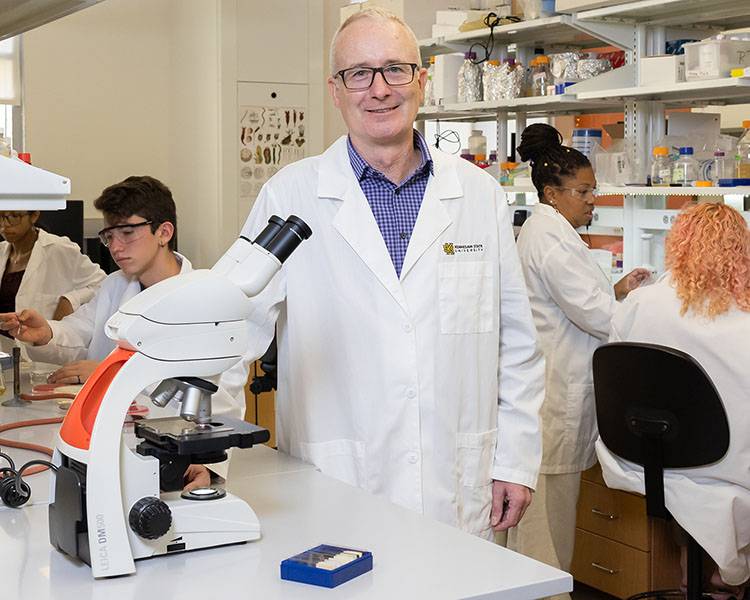
“This gene is important for multiple parts of neural development,” Hudson said. “We've looked at three or four markers of different genes that we think might be affected, and those markers all go away when you get rid of this gene. What we don't know is what happens to those cells when they go away.”
Hudson’s lab uses a microscopic worm called Caenorhabditis elegans, which has a nervous system that shares some similarities to that of humans. The worms are also transparent, meaning the worm’s genes can be highlighted with fluorescently-tagged proteins to enable better observation of neurological formation.
He described a process of locating the ortholog CEH-27, which mimics the human’s NKX 2.1 protein, and manipulating its transcription factor, a protein that can regulate specific genes throughout the life of cells and organisms. The ability to promote or inhibit a specific gene’s expression has significant medical applications, including treating neurological disorders at the microscopic level within the brain.
Beyond this, the study involves looking at multiple generations of worms to see if the genetic factors in neurological disorders get passed down, which could lead to better medical interventions. Hudson suggested a massive study with subjects numbering in the thousands, comparing the DNA between patients who present with neurological disorders like schizophrenia, autism, or depression with relatives who don’t present with those symptoms.
“You start to see associations with things like transcription factors, transcriptional terminators – the things that control DNA on and off,” he said. “While researching that, we were looking at CEH-27 as a candidate controller for neurogenin, which is one of the previous papers we published. The neurogenin has an association with autism, I believe, as well as a schizophrenia association. So, we knew we were in the right place.”
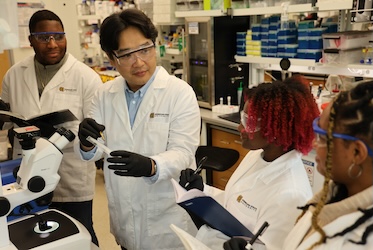
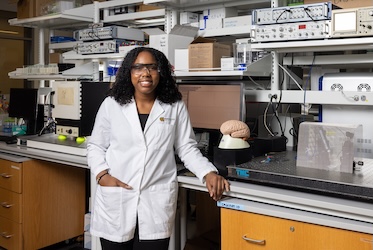
The grant also has a significant component for undergraduate and graduate research — appropriate given the involvement of student researchers in Hudson’s laboratory since he arrived at KSU’s College of Science and Mathematics in 2010. Recent Double Owl graduate Lindsey Knight conducted research that led to her master’s thesis on the topic and will begin her neuroscience doctorate at the Georgia Institute of Technology this fall. Knight had help from Fall 2025 bachelor’s graduate Essix Moser, who will begin his neuroscience doctoral degree at Texas A&M University this fall. Hudson also has rising junior biology major Tania Mechaca working in the lab to help with the research.
Hudson said the goal is to publish papers based on this study and continue to push the research forward with the help of student researchers.
“Hopefully I can use this work to recruit some more students,” Hudson said. “This study depends on student participation, and I’ve had a pretty good track record in helping students get published and move on to graduate programs, so I’d love to get them involved.”
This grant is funded through NIH Project No. 1R15NS141048-01A1.
Story by Dave Shelles
Photo by Matt Yung
A leader in innovative teaching and learning, Kennesaw State University offers undergraduate, graduate, and doctoral degrees to its more than 51,000 students. Kennesaw State is a member of the University System of Georgia with 11 academic colleges. The university's vibrant campus culture, diverse population, strong global ties, and entrepreneurial spirit draw students from throughout the country and the world. Kennesaw State is a Carnegie-designated doctoral research institution (R2), placing it among an elite group of only 8 percent of U.S. colleges and universities with an R1 or R2 status. For more information, visit kennesaw.edu.