KENNESAW, Ga. | Sep 21, 2026
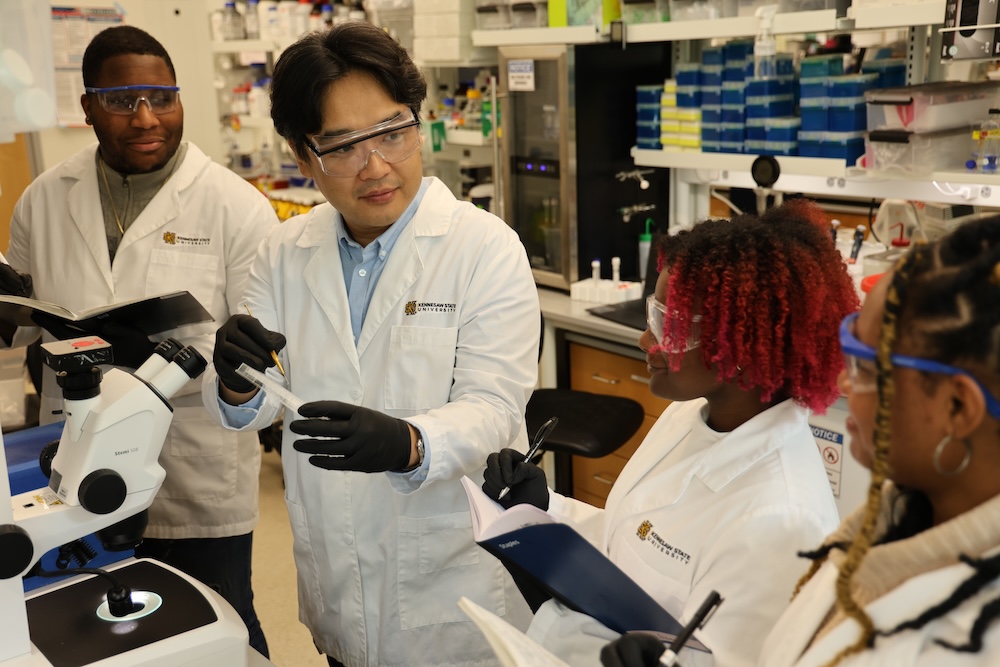
The assistant professor of molecular biology earned an R16 grant from the NIH’s National Institute of Allergy and Infectious Diseases (NIAID) to continue his study of an essential enzyme, called PMT, in protozoan parasites in hopes of finding an attackable weak spot for therapies that treat parasitic diseases.
Lee also earned an NIH Shared Instrumentation (S10) grant from the National Institute of General Medical Sciences (NIGMS) to acquire a fully automated isothermal titration calorimeter (ITC) instrument that will strengthen and expand KSU’s capacity for biomedical research and interdisciplinary studies. Together, the grants total $825,487.
“I first isolated this PMT enzyme about 20 years ago from a parasitic nematode known as the barber’s pole worm, and I’m thrilled to receive these grants to expand this work across multiple parasites,” he said. “This will allow us to increase the knowledge of phospholipid biosynthesis in these parasites so that we can discover treatments for some very common and harmful conditions.”
Lee studies the biological machinery that helps disease-causing parasites survive. By identifying enzymes that parasites need but humans do not have, his research aims to lay the groundwork for new drugs to treat infections such as malaria and diseases caused by parasitic nematodes affecting humans and plants. The project also gives undergraduate and graduate students opportunities to participate in cutting-edge biomedical research.
The NIGMS instrumentation grant will help advance that research while expanding Kennesaw State’s biomedical research capabilities. It also places KSU among a select group of institutions with a highly specialized analytical instrument that will allow researchers across disciplines to more closely examine molecular interactions, including protein-drug binding.
“To my knowledge, within the state of Georgia, a highly automated and sensitive system at this level is not currently available at any other academic institution, and KSU will now be able to offer this capability,” Lee said. “I am very pleased that this award will help elevate KSU’s research capacity by strengthening our research infrastructure and providing our faculty and students with access to an advanced biophysical and pharmaceutical research resource.”
The grants are the latest accolades for Lee, who earned KSU’s Outstanding Teaching Award for the 2025-26 school year. In addition, undergraduate researchers from his lab participated in the Birla Carbon Scholars and the Inspire Summer Scholars through KSU’s College of Science and Mathematics. Lee has also been named to the editorial board of the Journal of Biological Chemistry, with his term beginning in 2028. He is among only a few researchers from a Carnegie R2 institution so honored by one of the foremost journals in the fields of biochemistry and molecular biology.
The grants are under NIH numbers 1S10GM164865-01 and 1R16AI201126-01.
– Story by Dave Shelles
Photos by Leah Weaver
A leader in innovative teaching and learning, Kennesaw State University offers undergraduate, graduate, and doctoral degrees to its more than 51,000 students. Kennesaw State is a member of the University System of Georgia with 11 academic colleges. The university's vibrant campus culture, diverse population, strong global ties, and entrepreneurial spirit draw students from throughout the country and the world. Kennesaw State is a Carnegie-designated doctoral research institution (R2), placing it among an elite group of only 8 percent of U.S. colleges and universities with an R1 or R2 status. For more information, visit kennesaw.edu.