KENNESAW, Ga. | Oct 9, 2026
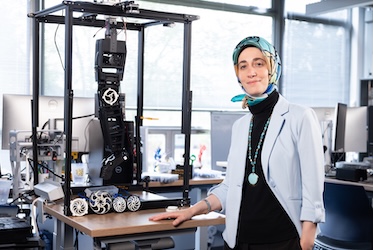
A robotic hand capable of grasping a patient’s wrist and measuring vital signs may sound futuristic, but Kennesaw State University mechatronics engineering student Daksh Garg is already bringing the concept to life through research in robotics and biomedical sensing.
The Southern Polytechnic College of Engineering and Engineering Technology student is building a 3D-printed robotic hand equipped with sensors designed to collect health information while interacting with a person.
“The whole point of the robotic hand is to merge robotics and biomedical sensing into one thing,” said Garg, a graduate of FCS Innovation Academy in Alpharetta. “It moves as a normal human hand would, and I’m going to integrate fingertip sensors so that I can monitor vitals of patients.”

Garg uses fishing wire to mimic tendons that move the fingers. Bearings serve as joints, while silicone will create a skin-like exterior. Fingertip sensors are expected to measure heart rate, blood oxygen levels, and skin conductance, while an accelerometer will detect movement.
The system works by bringing the sensors into direct contact with a person’s wrist. As the robotic hand closes around the wrist, sensors positioned in the fingers can detect a pulse and collect readings such as heart rate and blood oxygen levels. Garg then uses a Raspberry Pi computer to control the motors that move the fingers and coordinate the hand’s motion.
The project began with an idea supported by an Office of Research seed grant, titled ‘Healing Hands,’ to develop robotic hands that could continuously support a user or patient during emergency care or serve in an assistive caregiving role. That idea evolved through Garg’s work in the First-Year Scholars Program with Assistant Professor of Robotics and Mechatronics Engineering Razvan Voicu, his faculty research advisor.
“Daksh has shown a strong ability to bring together mechanical design, programming, and biomedical sensing in a way that addresses a real-world challenge,” Voicu said. “His project demonstrates how mechatronics can be used to develop practical technologies that could eventually support patients and healthcare professionals.”
Affordability is another goal. Garg estimates commercially available robotic hands can cost about $3,000, while his 3D-printed design could cost $500 to $600.
His prototype is mechanically complete, and he is now installing fingertip sensors and developing software that allows the hand to close around a person’s wrist.
Ultimately, Garg hopes the robotic hand can reduce routine responsibilities for medical professionals while making patient monitoring easier in hospitals and assisted living environments.
– Story by Raynard Churchwell
Photo submitted
A leader in innovative teaching and learning, Kennesaw State University offers undergraduate, graduate, and doctoral degrees to its more than 51,000 students. Kennesaw State is a member of the University System of Georgia with 11 academic colleges. The university's vibrant campus culture, diverse population, strong global ties, and entrepreneurial spirit draw students from throughout the country and the world. Kennesaw State is a Carnegie-designated doctoral research institution (R2), placing it among an elite group of only 8 percent of U.S. colleges and universities with an R1 or R2 status. For more information, visit kennesaw.edu.