


KENNESAW, Ga. | Apr 2, 2026
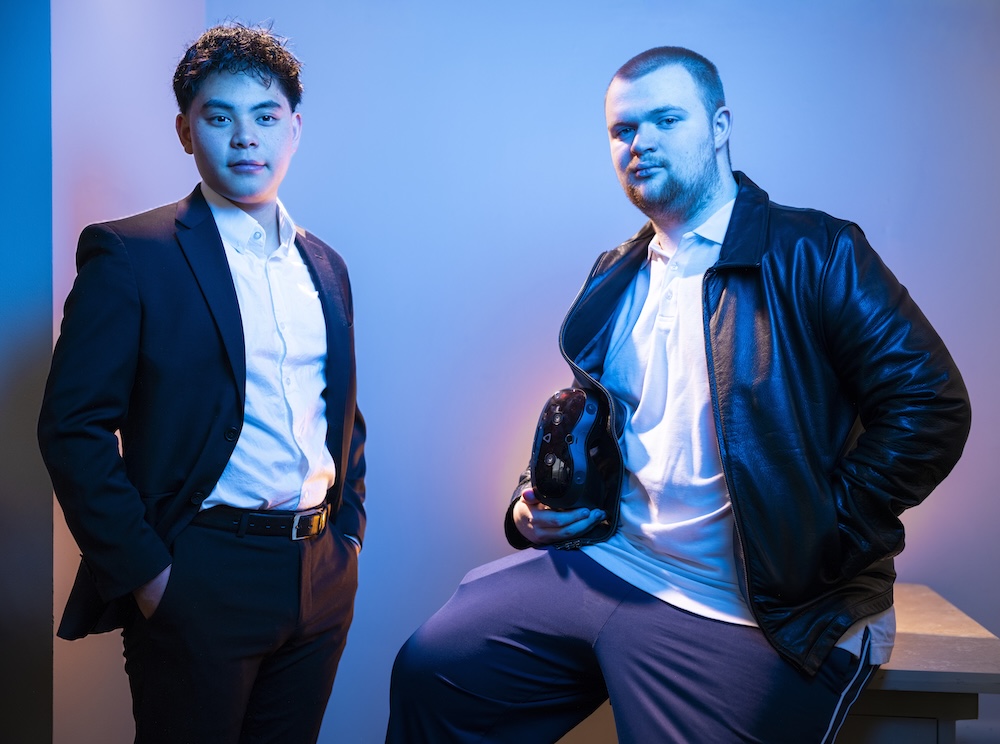
Through the Office of Research’s First-Year Scholars Program, computer science major Joshua Hentz of Chickamauga, Georgia, and software engineering major Caleb Tran of Suwanee, Georgia, are gaining early hands-on research experience through the Fallguard project in Kennesaw State’s College of Computing and Software Engineering. The duo is working under the purview of mentor M. Rasel Mahmud, assistant professor of computer science and the project’s principal investigator.
Fallguard is designed to address a critical challenge in virtual reality, helping users maintain balance while immersed in a digital environment. The system combines motion sensors, artificial intelligence, and 3D virtual modeling to track how a user moves while wearing a VR headset. By studying how a person moves and maintains stability over time, the technology can identify when a user is approaching a loss of balance.
“In simple terms, it’s an AI that predicts when you are about to fall and gives you advice to avoid it,” Hentz said.
As users move within a virtual environment, Fallguard continuously processes real-time data from sensors. The system evaluates changes in movement and compares them to trained data models. When those patterns cross a critical threshold, it can respond with alerts such as warning sounds or prompts to help the user regain balance before a fall occurs. Future developments could include emergency notifications if a user becomes unresponsive.
The need for this type of technology is increasing as virtual reality expands into gaming, fitness, and rehabilitation. While immersive experiences enhance engagement, they can also interfere with natural balance and spatial awareness.
“It kind of messes with your perception,” Hentz said. “Like when you close your eyes and try to stand on one leg.”
Working alongside faculty and doctoral researchers, the students are building a strong technical foundation early in their academic careers. Their responsibilities include reviewing scientific literature, analyzing datasets, and beginning development using Unity, along with programming languages like C# and Python.
For both students, the opportunity to conduct research as first-year students was unexpected but valuable. Tran said the experience has pushed him to grow academically while exposing him to new areas of technology.
“I did not expect to be doing research like this in my first year, but I’m really glad I took the opportunity,” Tran said. “I didn’t know much about AI or machine learning before this, and now I’m learning how it works and how it can be applied.”
Hentz said the project has given him a clearer understanding of what a future career in technology may look like.
“It’s insight into what it’s going to be like in the real world,” he said.
CCSE Interim Dean Yiming Ji said the students’ work reflects the college’s commitment to experiential learning.
“Joshua and Caleb are taking initiative early in their academic careers, and that is exactly what we want to see from our students,” Ji said. “Their work on Fallguard shows how experiential learning can build both technical skills and confidence, preparing them to contribute in meaningful ways to the future of technology.”
– Story by Raynard Churchwell
Photos by Darnell Wilburn
Kennesaw State researcher receives $250,000 NSF grant to enhance construction education
NSF-funded research aims to make AI a more reliable tool for heart testing
Kennesaw State researcher brings AI lessons to life with shark teeth
Engineering student creates robotic hand designed to track patient health
A leader in innovative teaching and learning, Kennesaw State University offers undergraduate, graduate, and doctoral degrees to its more than 51,000 students. Kennesaw State is a member of the University System of Georgia with 11 academic colleges. The university's vibrant campus culture, diverse population, strong global ties, and entrepreneurial spirit draw students from throughout the country and the world. Kennesaw State is a Carnegie-designated doctoral research institution (R2), placing it among an elite group of only 8 percent of U.S. colleges and universities with an R1 or R2 status. For more information, visit kennesaw.edu.

