


KENNESAW, Ga. | Mar 6, 2026
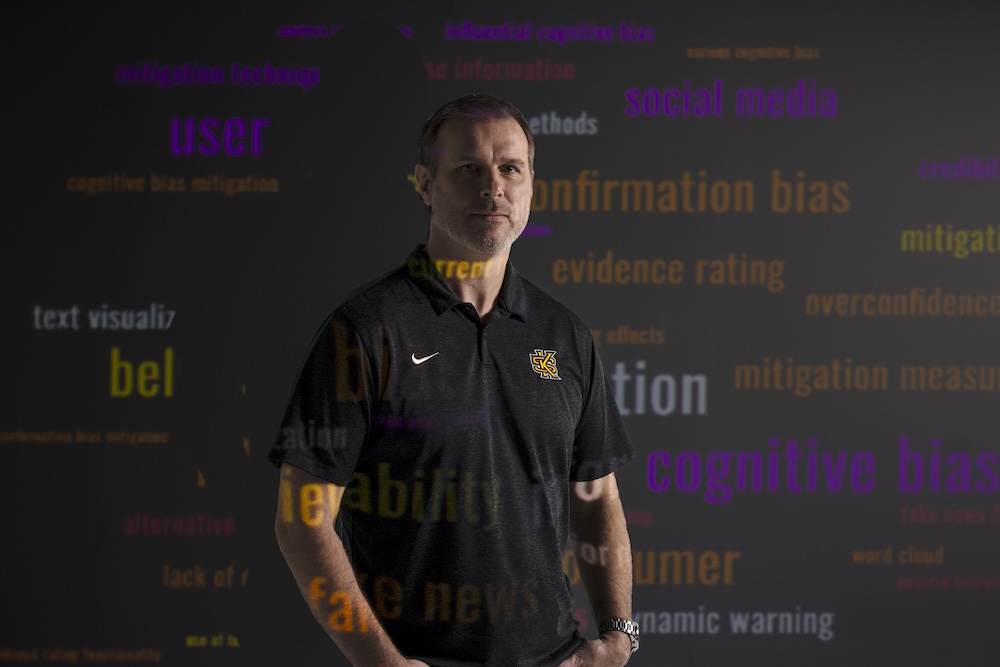
In a study published in the Information Systems Frontiers journal, French, an associate professor in the Michael J. Coles College of Business examined how and why people choose to believe and spread false information online. He found that emotional appeal was the strongest factor that determined belief.
“When information feels personally relevant or triggers anger or fear, people are far more likely to accept it, like it and share it,” French said.
French defines fake news as news articles posing as legitimate news from non-journalistic sources that contain verifiably false information with the intention to deceive.
For the study, French and co-authors Amrita George and Veda C. Storey, of Georgia State University; and Joshua Madden, of the University of Tennessee, analyzed some 10,000 social media posts collected during the 2020 coronavirus outbreak. They developed what they call the Content Dimensions–Overton Window–Perceived Utility model to better understand how people evaluate questionable information in uncertain situations. The model looks at three main factors in any piece of news: veracity (how true it is), emotional appeal (how it makes you feel), and relevance (how closely it connects to your life).
They found that individuals are highly sensitive to tone and emotional appeal when deciding to accept or reject news items.
Interestingly, researchers also found that people's view and tolerance of what is acceptable as being 'true enough' has changed over time.
“The Overton window acknowledges that people have a tolerance for a piece of information being close enough that they might not bother to spend time verifying it to be true,” said Storey, a professor of computer information systems at GSU. “The Window seems to be widening significantly, which results in people believing things that are more extreme.”
This, she explained, allows fake news to be more extreme and have a wider impact on society.
“Fake news resembles tabloid news in almost every way,” French added. “The difference is ambiguity. When a tabloid talks about celebrities having alien babies, people can easily tell it’s fake and just for entertainment. But fake news pretends to be real reporting.”
When in doubt, French says education and verification can help. His simplest advice is to go to the source.
“When you read something, my recommendation is to avoid having an immediate emotional reaction,” French said. “Don’t go to social media and start posting or reacting to it. Go research if it’s something that you feel passionate about that really gets your emotions up. Check the source first and learn about it. Listen to the actual speech or read the actual document for yourself. Don’t just read one quick story, have an emotional reaction, and share the story without knowing what's taking place.”
He points to Finland’s national media-literacy curriculum, which teaches students from an early age how information can be manipulated, as a promising model.
French also acknowledged that artificial intelligence has complicated the landscape as AI-generated content images and videos appear to be realistic and can make deception easier.
“AI doesn’t create fake news. People do,” he said. “But it makes disinformation far more effective. Some videos are so real you can’t tell the difference.”
Despite the challenges, French believes understanding the psychology behind why people believe fake news can help reduce misinformation.
“This study is important because once we understand those causes of why people start believing information, we can try to reduce misinformation and help people verify what they read,” he said. “We can develop approaches to overcome that and reduce that believability, reduce that viral impact. That’s how we get back to real conversations instead of emotional reactions.”
– Story by Christin Senior
Photos by Katherine Seghers
Kennesaw State researcher receives NIH Grant to study sleep apnea
Kennesaw State and Ingenico create hub for fintech innovation and learning

Student cooks up success through engineering and content creation
Kennesaw State researcher developing safer, more efficient computing systems for intelligent vehicles
A leader in innovative teaching and learning, Kennesaw State University offers undergraduate, graduate, and doctoral degrees to its more than 51,000 students. Kennesaw State is a member of the University System of Georgia with 11 academic colleges. The university's vibrant campus culture, diverse population, strong global ties, and entrepreneurial spirit draw students from throughout the country and the world. Kennesaw State is a Carnegie-designated doctoral research institution (R2), placing it among an elite group of only 8 percent of U.S. colleges and universities with an R1 or R2 status. For more information, visit kennesaw.edu.

