KENNESAW, Ga. | Sep 24, 2026

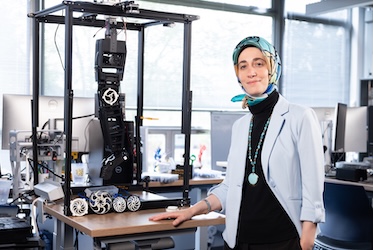
Kennesaw State University computer science researcher Kun Suo is working to improve how those systems operate through a $356,782 National Science Foundation (NSF) grant focused on developing more efficient and secure computing infrastructure for intelligent vehicles.
The project, “CSR: Co-Designing Virtualization and System Infrastructure for Efficient Vehicle Computing and Safe Onboard Intelligence,” explores how vehicle hardware and software can work together to process complex information while reducing delays and protecting critical driving functions.
Modern vehicles increasingly resemble small data centers. In addition to basic operations, their computing systems may simultaneously support driver-assistance technology, navigation, sensors, connectivity, entertainment, and artificial intelligence applications. Unlike traditional computing environments, however, a delay or failure inside a moving vehicle can have immediate consequences.
“The new vehicles today are more and more like a computer,” Suo said. “We want to make the vehicle computing very, very efficient, very, very fast, and use fewer resources.”
Suo, an associate professor of computer science in Kennesaw State’s College of Computing and Software Engineering, is examining how those competing demands can be better managed.
A key component of the research is virtualization, which allows multiple software applications to share the same physical computing hardware while operating within separate environments. Suo’s project seeks to create frameworks that more effectively separate safety-critical vehicle functions from less critical digital services.
The goal is to help the vehicle decide how its computing power should be used at any given moment. Systems tied directly to driving and safety would be given greater protection and priority, while less critical features could continue operating without interfering with those essential functions.
The research also addresses how those systems can operate securely. By creating stronger separation between critical driving functions and secondary applications, Suo and his team hope to reduce the chances that problems in one area of a vehicle’s computing system could interfere with another.
“The biggest challenge here is to know the hardware and know the software and know how the entire system stacks so that we can make it more efficient and safer,” Suo said. “I can bring my older knowledge and experience into this new topic.”
The researchers are approaching the challenge from both the hardware and software sides. One part of the project focuses on improving the efficiency of artificial intelligence workloads, including how computing tasks are scheduled and how information moves through the system. Another explores security mechanisms that can better isolate applications with different levels of importance.
Suo’s work builds on his previous research examining edge computing, which processes information closer to where it is generated rather than sending it to a distant cloud server. He received NSF funding in 2021 and 2022 for research focused on improving the efficiency, performance, and energy use of edge and Internet of Things computing systems.
Beyond its potential impact on future transportation, the project will create research opportunities for Kennesaw State students. Suo plans to involve doctoral, master’s and undergraduate students in the work, giving them opportunities to collaborate on different aspects of the project.
Suo sees the project as part of a larger shift in how computing will shape transportation.
“I’m very excited about vehicle computing and onboard intelligence,” Suo said. “I believe there will be more intelligence in the future and also more computing integrated into the vehicle platform.”
– Story by Raynard Churchwell
Photo provided
A leader in innovative teaching and learning, Kennesaw State University offers undergraduate, graduate, and doctoral degrees to its more than 51,000 students. Kennesaw State is a member of the University System of Georgia with 11 academic colleges. The university's vibrant campus culture, diverse population, strong global ties, and entrepreneurial spirit draw students from throughout the country and the world. Kennesaw State is a Carnegie-designated doctoral research institution (R2), placing it among an elite group of only 8 percent of U.S. colleges and universities with an R1 or R2 status. For more information, visit kennesaw.edu.