


KENNESAW, Ga. | Sep 29, 2026
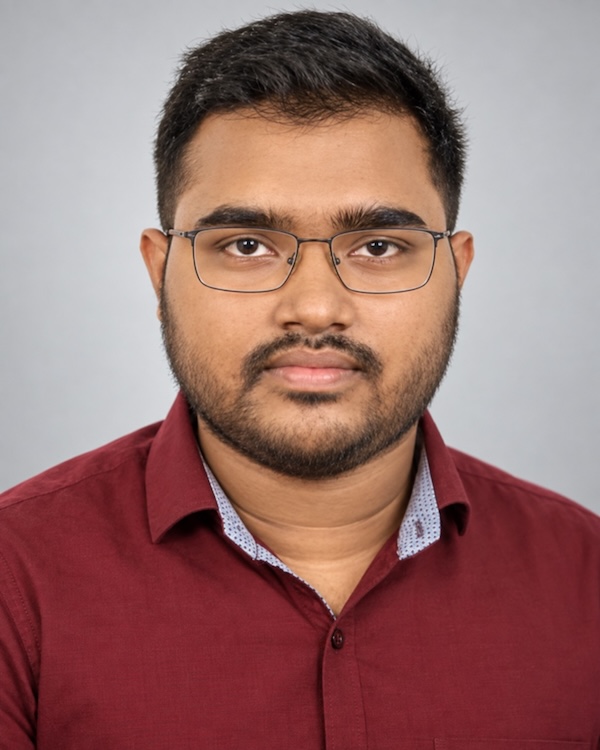
Shadin, a student in KSU’s Ph.D. in Computer Science program, was the first author of two papers accepted at international AI conferences in 2026. He co-authored the first with KSU researchers Aaron Cummings, Xinyue Zhang, and Bobin Deng. His co-authors on the second were Zhang, Jingyi Wang of San Francisco State University and Miao Pan of the University of Houston. Shadin also received a Doctoral Consortium Award from the International Neural Network Society after presenting his research in Maastricht, Netherlands.
In the first paper, “Feature Importance Based Optimized Multi Teacher Knowledge Distillation in Heterogeneous Federated Learning Environment” (FedMTFI), presented at the 2026 International Joint Conference on Neural Networks (IJCNN), Shadin and his co-authors developed a way for devices with different capabilities to help train a shared AI model. The method combines what those devices learn into a smaller model and identifies which information matters most to its decisions.
Their second paper, “Capability Aware Deep Q-Learning for Optimal Split Point Selection in Split Federated Learning” (QSplitFL), was accepted at the 2026 European Conference on Machine Learning and Principles and Practice of Knowledge Discovery in Databases (ECML PKDD). It examines how to divide the work between a device and a server based on the device’s computing power and network connection.
“The work started from a simple observation: hospitals are not allowed to share patient data, and most people do not own the newest phone,” Shadin said.
His research leverages federated learning. This approach lets phones, computers, or other devices train a shared AI model while keeping their data secured. The devices send information to the model instead of sending private records to a central location.
Keeping data private solves only part of the problem. Participating devices may have different amounts of memory, processing power, and network access. A low-memory device or a rural clinic’s computer may not be able to complete the same tasks as a more modern machine. If those devices are left out of the input process, the model also loses the chance to learn from their data.
In a paper presented at the International Joint Conference on Neural Networks, Shadin and his co-authors developed a way to group devices by their capabilities. Each group helps train a model suited to its equipment. Those models then help develop a smaller model that can run smoothly on less sophisticated devices.
The second paper, accepted at the European Conference on Machine Learning and Principles and Practice of Knowledge Discovery in Databases, takes another approach. It divides the work between a device and a server. The system chooses how much work the device should do based on factors such as its available processing power, battery level, and network connection.
“What I find worth defending about these two papers is that they beat methods which only run on expensive hardware, while running on the cheap hardware those methods leave out,” Shadin said.
The team tested both approaches using established research benchmarks. In one test, the method from the second paper achieved 83.73% accuracy while including devices with limited computing power. Shadin sees potential applications in healthcare, where clinics must protect patient records and may work with very different equipment. His mentor, Assistant Professor of Computer Science Xinyue Zhang, co-authored both papers with him and shares his goal of making AI more accessible.
“Nazmus has shown tremendous initiative in tackling a difficult problem,” Zhang said. “I am proud to see his research recognized internationally.”
– Story by Raynard Churchwell
Photo provided
NSF-funded research aims to make AI a more reliable tool for heart testing
Kennesaw State researcher earns prestigious NSF CAREER Award
Kennesaw State researcher receives NIH Grant to study sleep apnea
Kennesaw State researcher developing safer, more efficient computing systems for intelligent vehicles
A leader in innovative teaching and learning, Kennesaw State University offers undergraduate, graduate, and doctoral degrees to its more than 51,000 students. Kennesaw State is a member of the University System of Georgia with 11 academic colleges. The university's vibrant campus culture, diverse population, strong global ties, and entrepreneurial spirit draw students from throughout the country and the world. Kennesaw State is a Carnegie-designated doctoral research institution (R2), placing it among an elite group of only 8 percent of U.S. colleges and universities with an R1 or R2 status. For more information, visit kennesaw.edu.

