KENNESAW, Ga. | Dec 5, 2025
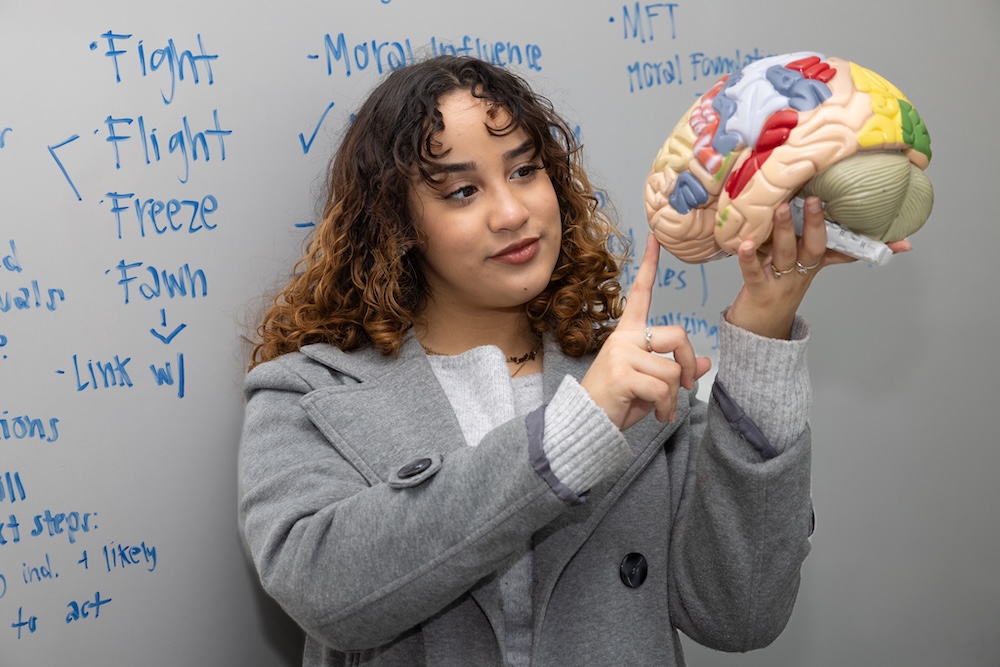
Martinez, a psychology major in the Norman J. Radow College of Humanities and Social Sciences explored the connection between instinctive fear reactions—fight, flight, freeze and fawn—and the moral principles people rely on when faced with high-stress situations. A participant in KSU’s Sophomore Scholars program, Martinez’ research was recently featured nationally at the American Society of Criminology Conference in Washington, D.C.
“Fear responses are inherent. You don’t think about them; you just react,” Martinez said. “I wanted to understand what drives that reaction, what morals, values or past experiences influence how a person responds when they’re under stress.”
Under the mentorship of assistant professor of criminal justice, Lisa Thompson, Martinez based her study on the moral foundations theory, which proposes that people’s moral judgments stem from instinctive, deeply rooted values. These include individualizing morals, which are focused on care, fairness and preventing harm; and binding morals, which emphasize authority, loyalty and group cohesion.
Martinez expected that people who valued care and fairness—individualizing morals—would be more likely to take moral action in stressful situations. Instead, she found that past experiences played a greater role.
“Both individualizing and binding morals played a role, but neither predicted behavior in the way I anticipated,” she said. “People’s past experiences including upbringing and trauma, as well as confidence levels and decision-making speed, had a larger impact than the type of morality they valued.”
She also found that participants who had a history of deviance were significantly more likely to choose the fight response in certain scenarios.
Understanding these influences, she said, could benefit mental health professionals, social workers, trauma specialists, and others who work closely with survivors of trauma.
Thompson believes these findings contribute to a growing effort to make interdisciplinary connections between the fields of criminology, psychology, and philosophy.
“As we learn more about how and why people choose to offend, we can develop a more humanistic approach to behavioral prevention and intervention efforts,” Thompson said. “This can allow us to better understand the individual, complicated, and sometimes seemingly irrational motivations that lead people to crime.”
At the American Society of Criminology Conference in Washington, D.C. in November, Martinez shared a 15-minute oral presentation to an audience of academic researchers and practitioners from across the country.
“That experience was incredible,” she said. “To present alongside researchers studying similar topics and share my own work at a national conference, it opened my eyes to what I can do in this field.”
A Marietta resident and Kell High School graduate, Martinez said she chose psychology because she has always been drawn to understanding people. She credits KSU’s First-Year Scholars and Sophomore Scholars programs for helping her discover a passion she didn’t know she had.
“KSU gave me the opportunity to explore research early, and that changed everything,” she said. “It has helped me grow my critical thinking, curiosity and my confidence. It’s one of the most meaningful experiences I’ve had.”
– Story by Christin Senior
Photo by Noelle Lashley
A leader in innovative teaching and learning, Kennesaw State University offers undergraduate, graduate, and doctoral degrees to its more than 51,000 students. Kennesaw State is a member of the University System of Georgia with 11 academic colleges. The university's vibrant campus culture, diverse population, strong global ties, and entrepreneurial spirit draw students from throughout the country and the world. Kennesaw State is a Carnegie-designated doctoral research institution (R2), placing it among an elite group of only 8 percent of U.S. colleges and universities with an R1 or R2 status. For more information, visit kennesaw.edu.