


KENNESAW, Ga. | Jan 28, 2026
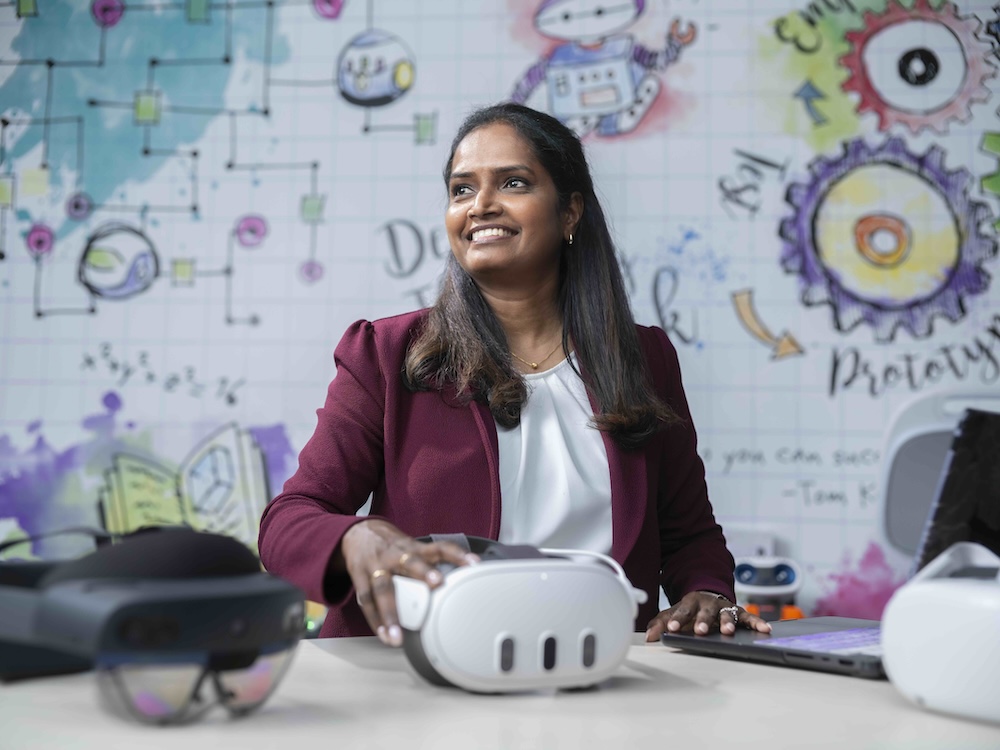
She enjoyed standing at the front of the classroom teaching small topics to her peers and was praised by her teachers in high school for that skill. Ultimately, all students learn differently, and all teachers teach differently.
Now, Titu is using advanced technology to equip future teachers with the skills needed to engage all learners in meaningful scientific discourse.
Titu, an associate professor of science education, is working on an NSF-funded project designed to use virtual reality (VR) to improve undergraduate education in STEM education.
The main objective of this project is to provide experiential learning through VR and AI simulations. These simulations will be accompanied by scaffolded peer teaching, focusing on scientifically relevant, real-world problem-based instruction.
“This research addresses the critical need in STEM education to equip future teachers with skills to engage students in meaningful scientific discussion,” Titu said.
The project, which is a collaboration between Kennesaw State University and four other universities (University of West Florida, Drake University, Texas A&M University and Southern Methodist University), aims to reach to 250 undergraduate STEM education students over four years.
Titu and her team are currently working to develop scenarios for the VR-AI simulations.
In the fall, they will begin recruiting and training participants to pilot the simulations and provide feedback. Through the testing process, they will improve the simulations based on the feedback they receive, eventually leading to measurable, technology-based teacher training.
These early steps will lay a foundation for scalable, technology-enhanced teacher preparation.
Titu described her willingness to embrace the growing role technology plays in education, saying immersive technologies like VR and AI have become essential in teacher education.
“With a growing emphasis on deliberate practice and authentic, problem-based learning, it is more important now than ever before that future teachers are prepared to face the realities of a classroom,” Titu said.
Titu’s research focuses on supporting both pre-service and in-service teachers integrating STEM pedagogy into their classroom practice. Working actively with students, Titu can see the results of her efforts firsthand.
“Engaging in research helps students develop critical thinking, problem-solving, and collaboration skills, which are essential for effective teaching,” Titu said. “It also gives them first-hand experience in innovative approaches to STEM education.”
As the project continues, its emphasis on immersive technology and peer-supported learning positions it to influence how STEM teachers are trained well beyond a single classroom or campus. By grounding teacher preparation in real-world problems, the research seeks to close the gap between theory and practice in science education.
“Those practices relate to those scientific real-world problems and science instruction,” Titu said, “and that will help better prepare our teachers to facilitate learning in ways that are more engaging and effective.”
– Story by Alyssa Ozment
Photo by Darnell Wilburn

Kennesaw State researcher receives NIH Grant to study sleep apnea
Student cooks up success through engineering and content creation
Kennesaw State researcher developing safer, more efficient computing systems for intelligent vehicles
Recent NIH grants aim to improve parasite research, acquire crucial instruments
A leader in innovative teaching and learning, Kennesaw State University offers undergraduate, graduate, and doctoral degrees to its more than 51,000 students. Kennesaw State is a member of the University System of Georgia with 11 academic colleges. The university's vibrant campus culture, diverse population, strong global ties, and entrepreneurial spirit draw students from throughout the country and the world. Kennesaw State is a Carnegie-designated doctoral research institution (R2), placing it among an elite group of only 8 percent of U.S. colleges and universities with an R1 or R2 status. For more information, visit kennesaw.edu.

