


KENNESAW, Ga. | Feb 3, 2026
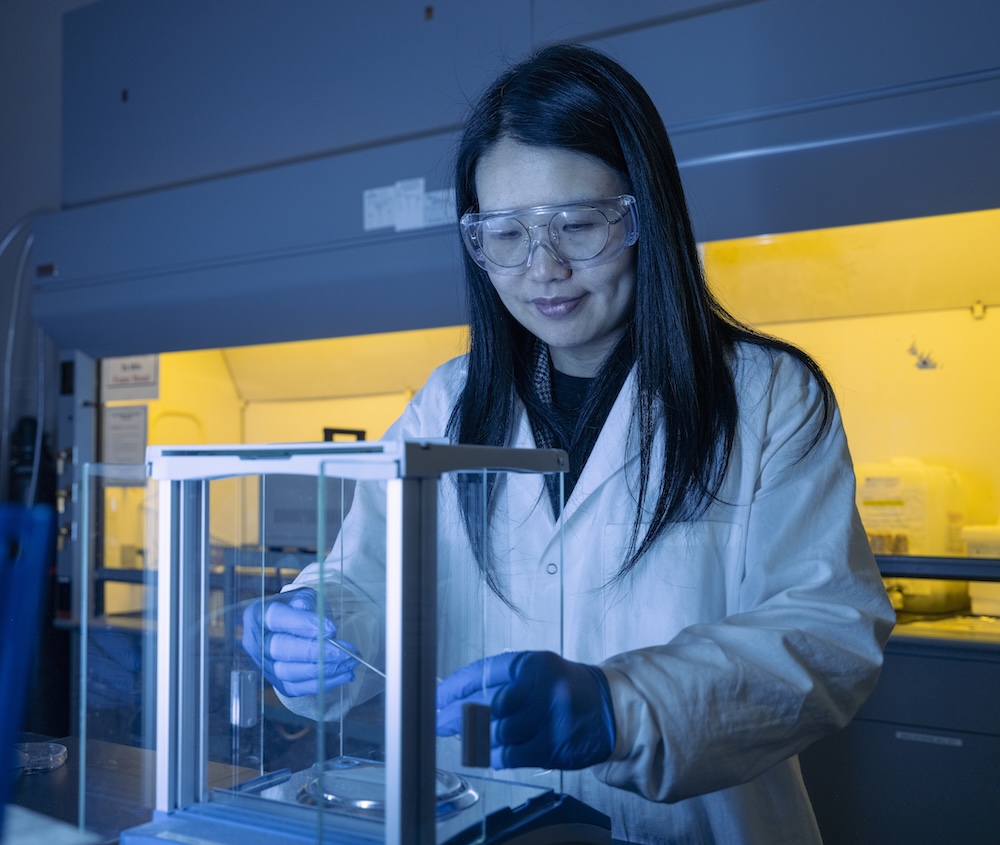
Beibei Jiang, an assistant professor in the Department of Electrical and Computer Engineering, leads a research team developing a sulfur-modified solid electrolyte designed to improve how lithium ions move through solid-state batteries, increasing performance while reducing safety risks.
“Our goal is to replace all those flammable components, so the battery becomes much safer,” Jiang said. “By removing the liquid electrolyte and redesigning the solid materials inside the battery, we can reduce the risk of overheating, short circuits, and fires while also improving performance.”
Solid-state batteries replace the flammable liquid electrolyte with a solid material that separates the battery’s electrodes and allows lithium ions to move during charging and discharging. While this design improves safety, lithium ions move more slowly through solids, which can limit charging speed.
Jiang’s team addressed that problem by adding sulfur-based chemical groups to a composite solid electrolyte made of ceramic and polymer components. The sulfur improves bonding between those materials, reducing resistance and allowing lithium ions to move more easily.
“The lithium ions are like cars on a highway,” Jiang said. “Our sulfur modification is like smoothing that highway so lithium ions can move faster, which means the battery can charge faster and perform better.”
The team also discovered a strong interaction between sulfur and zirconium in the ceramic portion of the electrolyte, a finding Jiang’s group is the first to identify and document.
“We are the first group proposing this strong interaction between sulfur and zirconium,” Jiang said. “We believe that this interaction is the main reason for the improved performance we are seeing.”
The discovery began when students noticed a reaction happening far more quickly than expected during early experiments.
“It was almost accidental,” Jiang said. “The reaction happened in just a few seconds and quickly got out of control. Instead of ignoring it, we asked why it was happening so fast and whether we could slow it down and make it controllable. That led us to this new design strategy.”
Lawrence Whitman, dean of the Southern Polytechnic College of Engineering and Engineering Technology, said the work reflects the applied focus of the college’s research.
“Dr. Jiang’s research addresses one of the most pressing challenges in energy storage today,” Whitman said. “By improving both safety and performance, her team is helping move solid-state battery technology closer to real-world application.”
The project is supported by a $200,000 grant from the National Science Foundation, along with seed funding from Kennesaw State’s Office of Research.
Most of the work takes place in Jiang’s lab on Kennesaw State’s Marietta Campus, where students synthesize materials, assemble prototype batteries, and test performance using small coin-cell designs.
“Our focus right now is to prove that this design works and that it is stable and reliable,” Jiang said. “Once we can show that, then we can think about scaling and manufacturing.”
Jiang believes the research has strong potential for electric vehicles, renewable energy storage, and consumer electronics.
Beyond the technology, she encourages students from a range of engineering backgrounds to get involved.
“No matter your background, you can contribute,” Jiang said. “The most important thing is to get started and get hands-on experience.”
As demand grows for safer and more efficient energy storage, Jiang’s work represents a promising step toward making solid-state batteries a practical alternative to today’s lithium-ion technology.
– Story by Raynard Churchwell
Photos by Darnell Wilburn

Kennesaw State researcher receives $250,000 NSF grant to enhance construction education

NSF-funded research aims to make AI a more reliable tool for heart testing
Kennesaw State researcher brings AI lessons to life with shark teeth

Engineering student creates robotic hand designed to track patient health
A leader in innovative teaching and learning, Kennesaw State University offers undergraduate, graduate, and doctoral degrees to its more than 51,000 students. Kennesaw State is a member of the University System of Georgia with 11 academic colleges. The university's vibrant campus culture, diverse population, strong global ties, and entrepreneurial spirit draw students from throughout the country and the world. Kennesaw State is a Carnegie-designated doctoral research institution (R2), placing it among an elite group of only 8 percent of U.S. colleges and universities with an R1 or R2 status. For more information, visit kennesaw.edu.

