KENNESAW, Ga. | Dec 1, 2025
According to the International Journal of STEM Education, students who learn science through virtual reality understand the material almost 50 percent better than those taught through traditional classroom methods, prompting Kennesaw State University researchers to explore how AI-powered VR might reshape the learning experience.
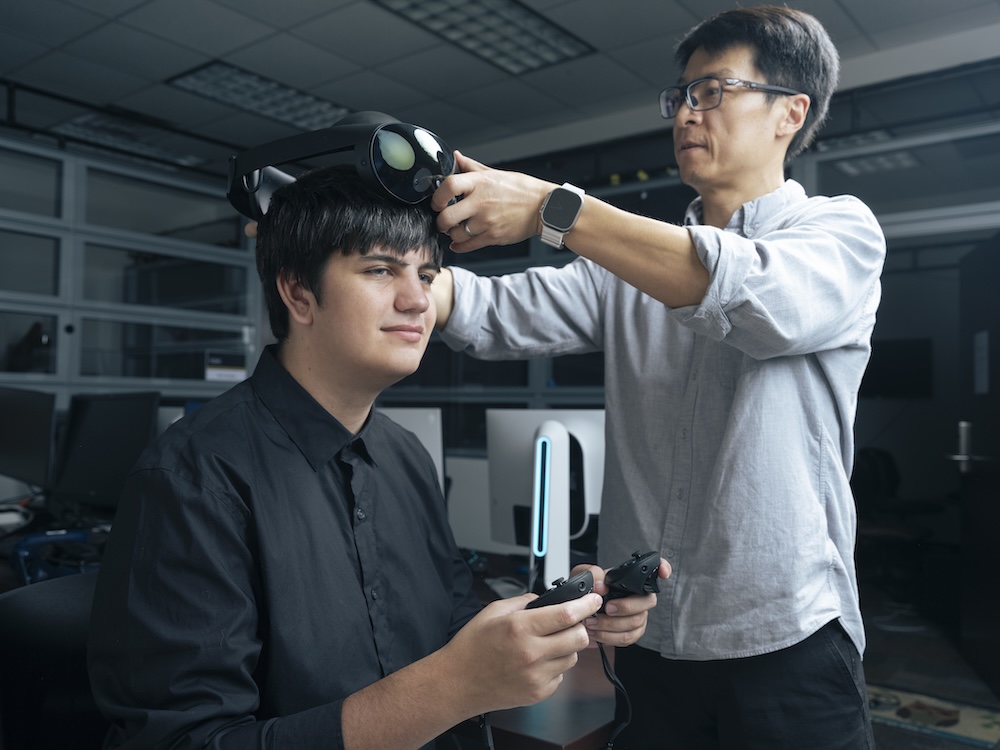
Under the mentorship of Assistant Professor of Game Development Lei Zhang, computer science student Devon Haynes is studying how virtual reality environments enhanced with large language model (LLM) tutors could help students better grasp complex subjects. Their project began in the First-Year Scholars Program, where Haynes and Zhang launched their study of the effect of VR storytelling on learning of DNA damage and repair mechanisms.
“The idea started with our earlier project that used a multi-user VR system to help students understand DNA damage and repair,” Zhang said. “We wanted to take that concept further by incorporating AI assistance, creating a virtual mentor that can support students as they learn collaboratively inside a virtual environment.”
Now part of the Sophomore Scholars Program, Haynes has expanded the project by integrating LLMs into the system. These AI-powered tutors respond in real time to user questions and actions, provide feedback, and guide group collaborations within the virtual world.
“A multi-user VR system and LLMs are two areas that haven’t been deeply explored together yet,” Haynes said. “A lot of existing research looks at one or the other, but not how they can interact in the same learning space.”
For Haynes, the experience has been both technically challenging and creatively rewarding. His day-to-day work involves reviewing studies, designing frameworks, and developing prototypes to connect the VR platforms with AI.
“There’s a lot that goes into connecting a large language model with VR,” he said. “But it’s exciting to build something that could actually change how people learn.”
The research also highlights the value of mentorship and hands-on learning at KSU. Zhang said he treats Haynes’s involvement much like that of a graduate student, encouraging independence while providing guidance.
“I treat Devon like a graduate student. I provide directions, but he takes initiative in experimentation and the ownership of the work,” Zhang said. “He’s shown genuine curiosity, strong initiative, and the ability to apply feedback. That’s what research at a graduate level is all about.”
Yiming Ji, interim dean of the College of Computing and Software Engineering, praised the collaboration as an example of how KSU’s research culture fosters innovation.
“Devon and Dr. Zhang’s work shows how computing research at KSU is shaping the future of education,” Ji said. “Their use of AI and virtual reality demonstrates the transformative power of technology when guided by curiosity and collaboration.”
For Haynes, the experience has reshaped his view of research.
“I didn’t really know what research was before college,” he said. “Now, I’ve learned how to collect and analyze data, write papers, and even publish. It’s given me confidence and opened doors I didn’t expect.”
Going forward, the pair plans to refine their prototype over the next year, test its effectiveness through user studies, and present their findings at academic conferences.
– Story by Raynard Churchwell
Photos by Darnell Wilburn
A leader in innovative teaching and learning, Kennesaw State University offers undergraduate, graduate, and doctoral degrees to its more than 51,000 students. Kennesaw State is a member of the University System of Georgia with 11 academic colleges. The university's vibrant campus culture, diverse population, strong global ties, and entrepreneurial spirit draw students from throughout the country and the world. Kennesaw State is a Carnegie-designated doctoral research institution (R2), placing it among an elite group of only 8 percent of U.S. colleges and universities with an R1 or R2 status. For more information, visit kennesaw.edu.